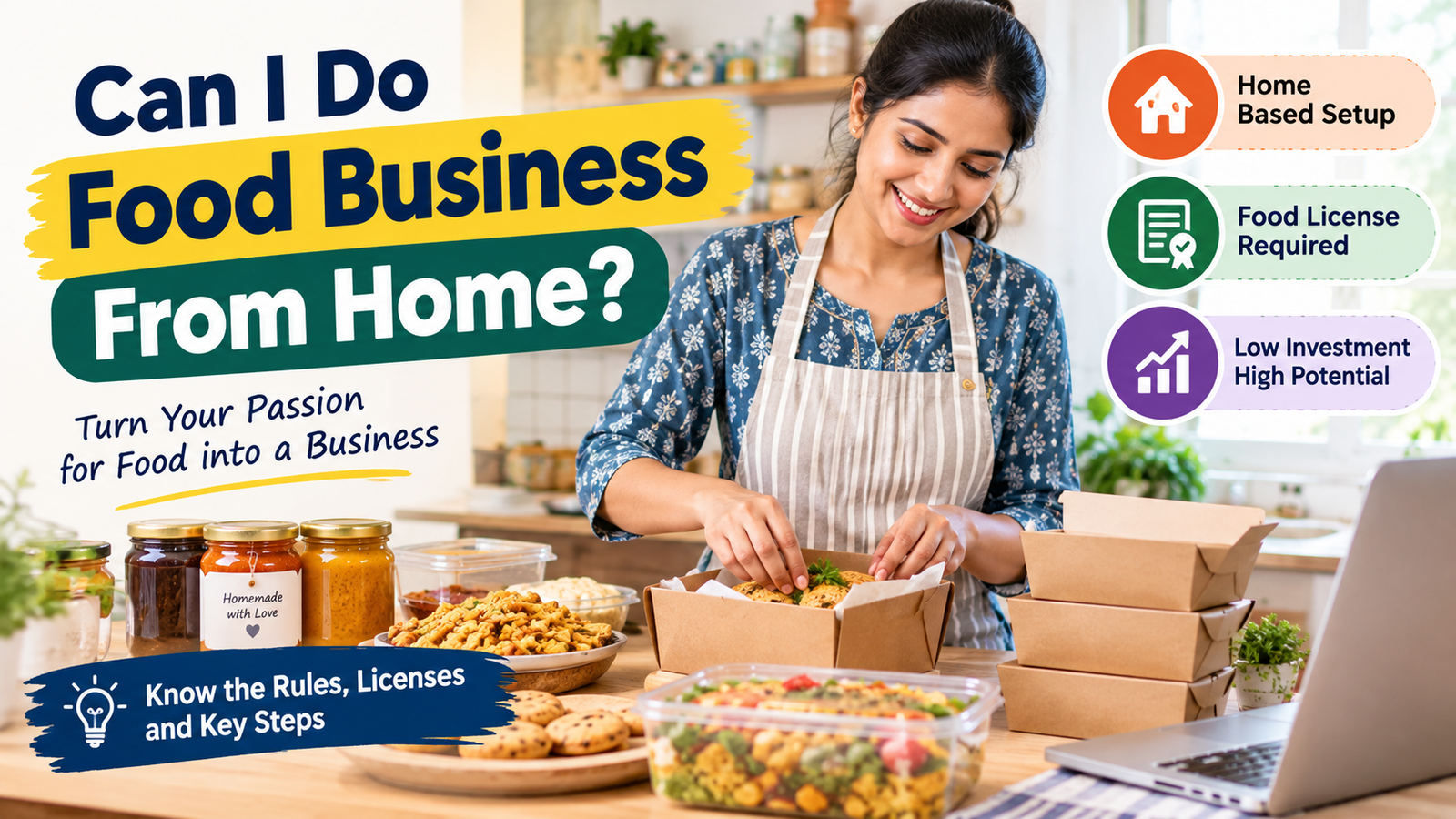
Can I Do Food Business From Home? FSSAI Guide
If you are wondering, “Can I do food business from home?”, the answer is yes. In India, many people run small food businesses from their homes, including home kitchens, tiffin services, homemade snacks, bakery products, pickles, sauces, sweets, catering services, and other food-related businesses.
However, starting a food business from home does not mean that you can sell food without following applicable food safety and licensing requirements. If you prepare, store, pack, distribute, or sell food commercially, you may need appropriate FSSAI registration or licence, depending on the nature and scale of your business.
A home-based food business can be a practical way to start with limited investment. But before accepting regular orders, it is important to understand the applicable food safety requirements, registration process, documents, hygiene practices, and business responsibilities.
Can I Do Food Business From Home?
Can I do food business from home? Yes, a food business can be operated from a residential premises when the business complies with applicable rules and requirements.
A home-based food business may include:
-
Homemade food and meal delivery
-
Tiffin services
-
Homemade cakes and bakery products
-
Pickles, chutneys and sauces
-
Namkeen and snacks
-
Homemade sweets
-
Packaged homemade food
-
Cloud kitchen operations
-
Small catering services
-
Homemade beverages
-
Regional or traditional food products
The exact requirements can depend on the type of food, production activity, turnover, scale of operation and how the food is sold.
For example, someone preparing a few meals for local customers may have different requirements from a home kitchen producing packaged snacks for sale across multiple locations.
Therefore, before starting operations, you should identify the nature and scale of your food business and check the applicable FSSAI category.
Is FSSAI Registration Required for a Home Food Business?
If you are asking “Can I do food business from home without FSSAI?”, you should first understand that food businesses are generally required to comply with food safety regulations applicable to their activities.
FSSAI registration or licensing is associated with food businesses and helps establish that the food business is operating under the applicable regulatory framework.
For many small food businesses, FSSAI Basic Registration may be applicable, while larger businesses or businesses falling under other categories may require a State or Central licence.
The applicable category should be determined based on the business activity and other relevant details rather than simply assuming that every home business needs the same licence.
What Is FSSAI Registration for a Home-Based Food Business?
FSSAI registration is commonly required for eligible small food businesses operating on a small scale. It provides a registration number that can be associated with the food business.
For a home-based entrepreneur, obtaining the appropriate food registration can be an important step before selling food commercially.
Depending on your business model, you may need to provide information such as:
-
Applicant details
-
Business or food activity details
-
Address of the premises
-
Type of food business
-
Food products being prepared or sold
-
Contact information
-
Identity and address-related documents, where applicable
The exact documents and requirements can vary according to the type of food business.
What Home Food Businesses Can You Start?
There are many food business ideas that can be operated from home. The right option depends on your skills, available kitchen space, investment and local demand.
1. Home Tiffin Service
A home tiffin service is one of the common options for people who want to start a food business with a relatively small setup.
You can prepare meals for:
-
Office employees
-
Students
-
Working professionals
-
Paying guests
-
Local families
If you prepare food regularly for commercial sale, you should check the applicable FSSAI requirements for your activity.
2. Homemade Bakery Business
You can also operate a small bakery business from home by preparing products such as:
-
Cakes
-
Cupcakes
-
Cookies
-
Brownies
-
Bread
-
Pastries
-
Muffins
If these products are prepared and sold commercially, appropriate food business registration or licensing requirements should be considered.
3. Homemade Snacks
Homemade snacks can include namkeen, chips, roasted products, traditional snacks and other food items.
If you package the products for sale, you should also pay attention to applicable packaging and labelling requirements.
4. Pickle and Chutney Business
Pickles, chutneys, sauces and similar products can be produced on a small scale from a suitable premises.
However, food safety, storage, packaging and labelling become particularly important when the products are prepared for commercial sale.
5. Cloud Kitchen From Home
A home kitchen may also be used for a delivery-based food business, depending on applicable local requirements.
A cloud kitchen can receive orders through online platforms, social media, websites or direct customer communication.
Before starting, check the requirements applicable to your location and food activity.
Can I Sell Homemade Food Online?
Yes, homemade food can be sold through online channels, subject to applicable legal, food safety and platform requirements.
A home food business may receive orders through:
-
A personal website
-
Social media
-
Messaging applications
-
Food delivery platforms
-
Local online marketplaces
However, selling through the internet does not remove food safety obligations.
If you are preparing food commercially and accepting regular orders, you should determine whether your business needs FSSAI registration or licensing and comply with applicable requirements.
Online platforms may also ask for business or food-related documents before allowing certain types of food sellers to operate.
What Documents Are Needed for a Home Food Business?
The documents required can depend on the type and scale of the food business.
For a small home-based food business, commonly requested information may include:
-
Applicant's identity details
-
Address proof
-
Photograph, where applicable
-
Details of the food business
-
Business premises information
-
Details of food products
-
Contact details
Additional documents may be required for particular categories or licence types.
Therefore, it is better to identify your exact food activity before preparing the application.
How to Apply for a Food Licence for a Home Business?
If you want to start a food business from home, the first step is to understand which FSSAI registration or licence category applies to your business.
A general process can include:
Step 1: Identify Your Food Business Activity
First, determine what you are doing. For example, you may be operating a tiffin service, bakery, home kitchen, packaged food business or catering service.
Step 2: Determine the Applicable FSSAI Category
Your business activity, scale and other relevant factors help determine whether Basic Registration, State Licence or Central Licence is applicable.
Step 3: Prepare the Required Information
Keep the required personal, business, premises and food activity details ready.
Step 4: Submit the Application
The application can be submitted through the applicable online system or with professional assistance.
Step 5: Application Processing
After submission, the application may go through the applicable processing and verification procedure.
Step 6: Receive the Registration or Licence
Once approved, the applicable FSSAI registration or licence details are issued according to the relevant procedure.
Do I Need a Separate Kitchen for a Home Food Business?
A separate commercial kitchen is not automatically required for every small home food business. However, the premises used for food preparation must meet applicable food safety and hygiene requirements.
Your kitchen should be maintained properly and should be suitable for preparing food for commercial purposes.
Important practices include:
-
Keep food preparation areas clean.
-
Store raw and cooked food appropriately.
-
Protect food from contamination.
-
Maintain clean utensils and equipment.
-
Use safe water.
-
Keep pests away from food preparation areas.
-
Follow proper personal hygiene.
-
Store ingredients safely.
-
Maintain appropriate temperature control where required.
The specific requirements can vary depending on the food activity.
Can I Start a Home Food Business Without a Commercial Shop?
A commercial shop is not necessarily required simply because you want to operate a food business. Some food businesses can be operated from home, depending on the nature of the activity and applicable local requirements.
However, you should not assume that a residential address automatically permits every type of commercial activity.
Apart from food safety requirements, you may also need to consider local municipal rules, housing or society restrictions, zoning requirements, fire safety requirements, waste disposal requirements and other applicable permissions depending on your location and business model.
Is FSSAI Registration Enough to Run a Home Food Business?
FSSAI registration or licensing addresses the food safety regulatory aspect of the business, but it may not automatically cover every other business requirement.
For example, depending on your circumstances, you may need to consider:
-
Local business permissions
-
Municipal requirements
-
GST-related requirements, where applicable
-
Shop and establishment requirements, where applicable
-
Packaging and labelling requirements
-
Fire safety requirements, where applicable
-
Waste management requirements
Therefore, entrepreneurs should look at the complete compliance requirements applicable to their particular business rather than relying on one registration alone.
Food Labelling for Homemade Packaged Products
If you are selling packaged food products, labelling becomes an important part of the business.
Depending on the product and applicable rules, food labels may need relevant information such as:
-
Name of the food
-
Ingredient information
-
Net quantity
-
FSSAI-related details
-
Date-related information
-
Batch or lot information, where applicable
-
Storage instructions, where required
-
Allergen-related information, where applicable
-
Manufacturer or packer details, as applicable
The exact labelling requirements depend on the type of food and packaging.
If you are planning to sell homemade products outside your local area, it is especially important to understand the applicable packaging and labelling requirements before scaling the business.
How Much Does It Cost to Start a Home Food Business?
The cost of a home food business can vary significantly.
Your initial investment may include:
-
Raw materials
-
Cooking equipment
-
Packaging
-
Kitchen improvements
-
Storage containers
-
Branding
-
Delivery expenses
-
Marketing
-
Food registration or licensing-related costs
-
Online platform charges, where applicable
One advantage of starting from home is that you may not need to pay rent for a separate commercial kitchen or shop.
However, the actual investment depends on the type and size of your food business.
Benefits of Starting a Food Business From Home
A home-based food business can offer several practical advantages.
Lower Initial Investment
You may already have basic kitchen equipment and space, reducing the need for a separate commercial premises.
Flexible Working
Home food businesses can provide flexibility, particularly for entrepreneurs who want to start small.
Easy Testing of Products
You can test different products and understand customer demand before expanding.
Local Customer Base
Tiffin services, bakery products and homemade food can initially target customers in nearby areas.
Scope for Expansion
Once your customer base increases, you can consider expanding production, adding employees or moving to a larger commercial facility, subject to applicable requirements.
Important Things to Check Before Starting
Before launching your home food business, make a basic checklist.
1. Decide what food you will sell.
Choose a specific product category instead of trying to sell everything initially.
2. Understand your customer.
Identify whether your target customers are families, students, office workers, local residents or online customers.
3. Check FSSAI requirements.
Determine the appropriate registration or licence for your business activity.
4. Maintain hygiene.
A clean and safe kitchen is essential for any food business.
5. Plan packaging.
Use suitable food-grade packaging and follow applicable labelling requirements.
6. Check local requirements.
Review municipal, residential and other applicable requirements for commercial activity from your premises.
7. Maintain records.
Keep important business and food-related records organized as your business grows.
Frequently Asked Questions
1. Can I do food business from home?
Yes. A food business can be operated from a home premises, provided the business complies with applicable FSSAI requirements, food-safety conditions and other local requirements. The exact registration or licence category depends on the nature and scale of the food business.
Source: FSSAI – Food Businesses
2. Can I sell homemade food without registration?
If you are operating a commercial food business, you should first determine the applicable FSSAI registration or licence requirement. FSSAI states that food businesses are covered by its licensing and registration framework.
Source: FSSAI Licensing & Registration Information
3. Do I need FSSAI for a home kitchen?
A home kitchen used for commercial food preparation may require FSSAI registration or a licence depending on the business activity and applicable eligibility criteria. Operating from a residential premises does not by itself remove food-safety compliance requirements.
Source: FSSAI Food Business Services
4. Can I start a tiffin service from home?
Yes. A tiffin service can be operated from home, subject to the applicable food-business registration or licensing requirements and food-safety conditions. The appropriate category depends on the nature and scale of the operation.
Source: FSSAI FoSCoS Licensing & Registration FAQs
5. Can I sell homemade cakes from home?
Yes. Homemade cakes and other bakery products can be sold commercially from a home-based setup when the applicable food-business requirements are followed. The appropriate FSSAI category should be determined according to the business activity and scale.
Source: FSSAI – Food Businesses
6. Can I sell homemade pickles online?
Yes. Homemade pickles can be sold commercially, including through online channels, subject to applicable food-safety, registration, packaging and labelling requirements. Packaged food products may also have specific labelling obligations.
Source: FSSAI Licensing & Registration FAQs
7. Can I run a cloud kitchen from home?
A home-based cloud kitchen may be possible depending on the business model, premises and local requirements. The food business should comply with the applicable FSSAI registration or licensing requirements before commercial operations begin.
Source: FSSAI – Food Businesses
8. Is FSSAI registration mandatory for every home food business?
Food businesses are subject to the FSSAI licensing and registration framework, but the applicable category can differ. Since 1 April 2026, FSSAI's revised turnover thresholds provide for Registration up to ₹1.5 crore, State Licence above ₹1.5 crore up to ₹50 crore, and Central Licence above ₹50 crore, subject to the applicable criteria for the food business.
Source: FSSAI Order on Revised Turnover Thresholds, 2026
9. Do I need a separate commercial kitchen for a home food business?
Not necessarily in every case. FSSAI licensing is based on the premises and the food-business activities conducted there. However, the premises must comply with applicable food-safety and hygiene requirements, and other local rules may also apply.
Source: FSSAI FoSCoS Licensing FAQs
10. Can I sell homemade food through food delivery apps?
You may be able to sell homemade food through online food-delivery channels, subject to the platform's requirements and applicable food-business regulations. FSSAI also recognizes e-commerce entities and food businesses operating through digital or electronic platforms.
Source: FSSAI Licensing FAQs – E-Commerce Food Businesses
11. What FSSAI licence do I need for a small home food business?
The applicable FSSAI category depends on the food activity and current eligibility criteria. Under the revised 2026 turnover thresholds, FSSAI Registration applies to eligible food businesses with turnover up to ₹1.5 crore, while higher turnover categories may require State or Central licensing.
Source: FSSAI Revised Turnover Threshold Order – 2026
12. Can I apply for FSSAI registration online for my home food business?
Yes. FSSAI provides online food-business registration and licensing services through FoSCoS. Applicants can use the online system to apply for the applicable registration or licence.
Source: FoSCoS – FSSAI Food Safety Compliance System
13. Do homemade packaged food products need an FSSAI number on the label?
Yes, where applicable, FSSAI's guidance states that petty food business operators with an FSSAI Registration number are also required to declare the registration number on product labels according to the applicable labelling specifications.
Source: FSSAI Licensing & Registration FAQs
14. Can I operate more than one food activity from my home premises?
FSSAI states that its licence is based on the premises and that different food-business activities conducted at the same premises can be covered through a single FSSAI licence, subject to the applicable requirements.
Source: FSSAI FoSCoS Licensing FAQs
15. Where can I apply for an FSSAI registration or licence?
Food businesses can use the FSSAI's FoSCoS system for applicable registration and licensing services. FSSAI's current business-services page provides options for applying for a licence, registration, tracking applications and managing related services.
Source: FSSAI Food Business Services
Final Words
So, can I do food business from home? Yes, a home-based food business can be a practical option for entrepreneurs who want to start small. Tiffin services, homemade bakery products, snacks, pickles, sauces, sweets and other food products can provide opportunities to build a customer base from home.
However, food businesses involve responsibilities related to food safety, hygiene, registration, packaging and labelling. Before starting commercial operations, identify your exact food activity and check the applicable FSSAI registration or food licence requirements.
If you are unsure which category applies to your home food business or need assistance with the application process, you can take professional assistance for understanding the documentation and application procedure.
1. क्या रजिस्ट्रेशन सालाना नवीकरण होता है?
2. क्या बिना GST नंबर के MSME पंजीकरण हो सकता है?
3. 12 अंकों का एमएसएमई पंजीकरण नंबर क्या है?
4. MSME प्रमाणपत्र क्या है?
5. MSME के अंतर्गत कौन-कौन से उद्योग आते हैं?
6. MSME के लिए कौन पात्र है?
- How to register on GeM portal
- GeM पोर्टल हेल्पलाइन नंबर 2026| कस्टमर केयर, ईमेल | टेंडर सहायता
- GeM पोर्टल क्या है | रजिस्ट्रेशन प्रोसेस, फायदे | सरकारी ऑर्डर पाने का तरीका (2026)
- एमएसएमई पंजीकरण 2026 | प्रक्रिया, लाभ, दस्तावेज़ | Udyam Guide
- जेम लॉगिन: GeM Login और रजिस्ट्रेशन की पूरी जानकारी

