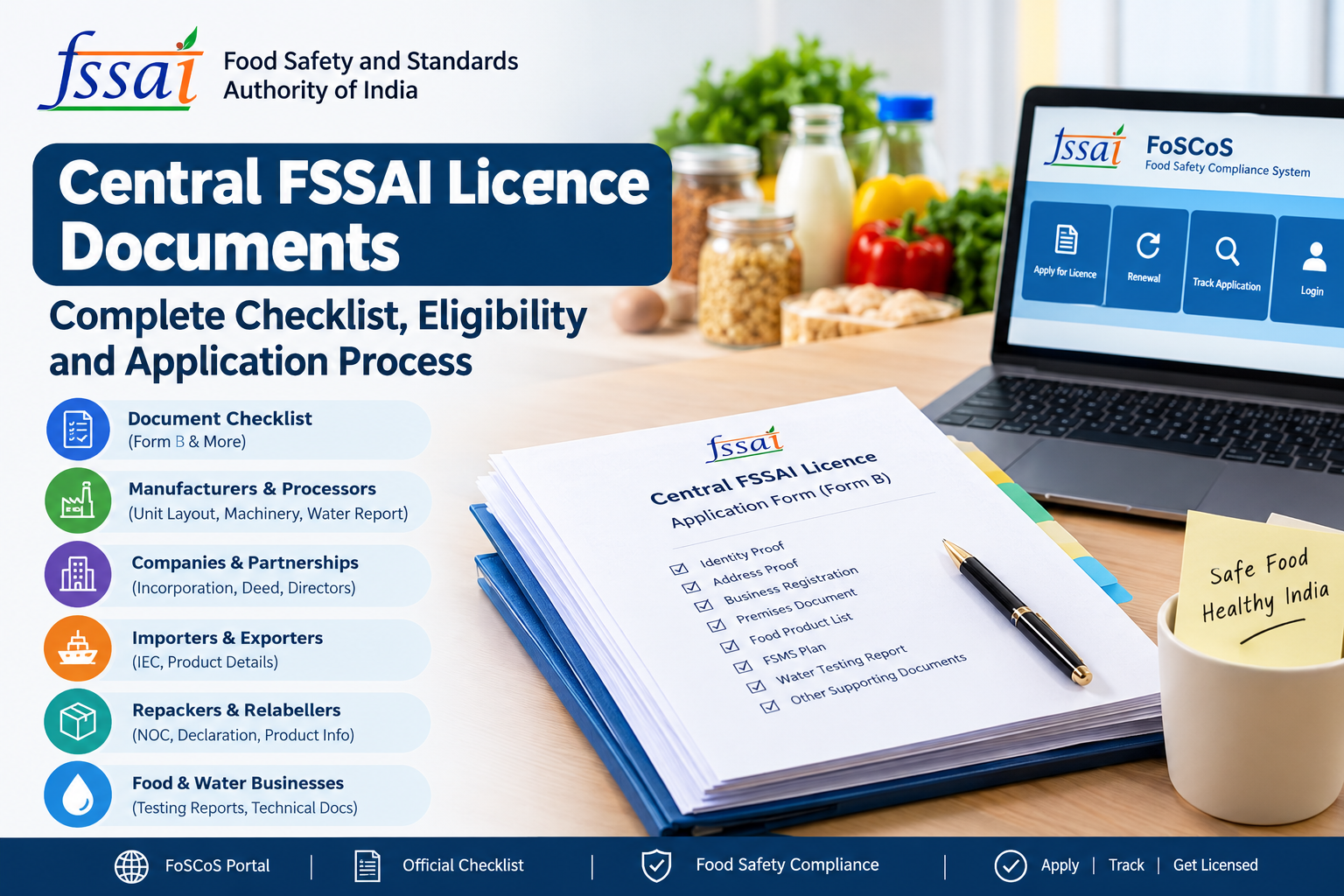
Central FSSAI Licence Documents | Required Documents | Apply Online
Central FSSAI Licence Documents are essential for food businesses that fall under the Central Licensing Authority of the Food Safety and Standards Authority of India (FSSAI). Before applying for a central food licence, a Food Business Operator (FBO) should prepare the required identity proofs, business registration documents, premises details, and food safety records. Depending on the type of business, additional documents such as a manufacturing unit layout plan, water testing report, machinery details, import documents, or turnover proof may also be required.
Businesses involved in food manufacturing, importing, large-scale distribution, and other activities covered by central licensing rules should understand the eligibility criteria before submitting an application through the FoSCoS portal.
This guide explains the documents required for a Central FSSAI Licence, the application process, common mistakes, and important points to check before applying.
Central FSSAI Licence Documents: Complete Document Checklist
The documents required for a Central FSSAI Licence depend on the nature of the food business and the activity for which the licence is requested. Some documents are generally applicable, while others are required only for specific business categories.
The commonly required documents include:
-
Duly completed Form B, signed by the proprietor, partner, or authorised signatory.
-
Identity proof and address details of the proprietor, partners, directors, or authorised signatory, as applicable.
-
Proof of possession of the business premises, such as a rent agreement, sale deed, or relevant utility bill.
-
Business constitution documents, such as a partnership deed, certificate of incorporation, or applicable proprietorship declaration.
-
List of food products or food categories handled by the business.
-
Food Safety Management System (FSMS) plan or related food safety documentation, as applicable.
-
Supporting proof of turnover, where required for the business category.
-
Additional documents specific to the activity, such as manufacturing, import, repacking, or transportation.
The official document checklist may differ depending on whether the application is for a new licence, renewal, modification, or conversion. Applicants should verify the latest requirements on the official FoSCoS portal before submitting their application.
FSSAI Central Licence Required Documents for Food Manufacturers
FSSAI Central Licence Required Documents for manufacturers depend on the products being manufactured, the production process, and the nature of the processing unit. Manufacturing businesses may need to submit technical documents that demonstrate the facility's suitability for food production.
Common manufacturing-related documents include:
-
Blueprint or layout plan of the processing unit, showing dimensions and the area allocated to different operations.
-
List of machinery and equipment, including their number, installed capacity, and horsepower where applicable.
-
List of food categories intended for manufacturing.
-
Water analysis report from a recognised or public health laboratory when water is used as an ingredient in food processing and the report is applicable to the activity.
-
Food Safety Management System plan or relevant food safety documents.
-
Details of the person responsible for food safety and regulatory coordination, where applicable.
-
Source of raw materials and other activity-specific supporting documents.
Manufacturers should ensure that the information in the application matches the actual operations of the unit. If the business plans to manufacture several food categories, the relevant categories should be selected accurately.
Central Food Licence Documents for Private Limited Companies and Partnerships
Central Food Licence Documents for companies and partnership firms include documents establishing the legal identity and ownership structure of the business.
Depending on the legal structure, the following may be required:
-
Certificate of incorporation for a company.
-
Memorandum of Association and Articles of Association, where applicable.
-
Partnership deed for a partnership firm.
-
List of directors, partners, or executive members, as applicable.
-
Full addresses and contact details of the relevant directors or partners.
-
Authorisation for the person submitting and managing the FSSAI application.
-
Form IX nomination and the relevant board resolution, where applicable to the company.
-
Identity and address details of the authorised signatory.
For a proprietorship, the applicant should provide the applicable declaration and supporting business documents requested by the portal.
The exact combination of documents depends on the business constitution and the type of food activity. Applicants should avoid uploading unrelated documents merely to increase the number of attachments.
FSSAI Licence Documents for Importers and Exporters
FSSAI Licence Documents for Importers may include additional records because food import activities involve regulatory and customs-related requirements.
Depending on the application category, importers may need to provide:
-
Business constitution and registration documents.
-
Identity and address proof of the proprietor, directors, partners, or authorised signatory, as applicable.
-
Proof of the business premises.
-
Importer-related supporting documents, including the Importer Exporter Code (IEC) issued by the Directorate General of Foreign Trade, where required.
-
Details of the food products being imported.
-
Supporting documents relevant to the specific food business activity.
-
Additional declarations or approvals requested by the applicable licensing authority.
An Importer Exporter Code is not a substitute for an FSSAI licence. Businesses importing food products should determine the applicable FSSAI licensing category and confirm the documentation requirements before beginning regulated activities.
Exporters should also check whether their food business activities require a Central FSSAI Licence and whether additional destination-country or export-related requirements apply.
FSSAI Licence Documents for Repackers and Relabellers
FSSAI Licence Documents for Repackers and Relabellers depend on whether the business repacks food, changes packaging, or applies its own label to food products manufactured by another business.
The relevant supporting documents may include:
-
Details of the original manufacturer or supplier.
-
Manufacturer's licence and a no-objection certificate, where required.
-
Declaration or undertaking applicable to repackers or relabellers.
-
Details of the food products being repacked or relabelled.
-
Premises documents for the operating facility.
-
Food safety and handling procedures, where applicable.
-
Details of the packaging and labelling activity.
A business should describe its actual operations correctly. Repacking, relabelling, manufacturing, storage, and distribution may fall under different activity classifications, so selecting the appropriate category is important.
FSSAI Central Licence Documents for Water-Based Food Businesses
FSSAI Central Licence Documents for Packaged Drinking Water Manufacturers can include specific testing and compliance records, depending on the product and applicable regulations.
Where required, documents may include:
-
Water analysis reports from a recognised or public health laboratory.
-
Pesticide residue reports for water, where applicable to the relevant category.
-
Manufacturing unit layout and equipment details.
-
Details of the water source and treatment process.
-
Food safety management documents.
-
Other applicable technical reports, approvals, or supporting documents.
Packaged drinking water and mineral water businesses should verify the current product-specific standards and licensing requirements before applying. Requirements can vary according to the activity, product category, and applicable regulatory provisions.
Central FSSAI Licence Documents for Milk and Meat Businesses
FSSAI Central Licence Documents for Milk Processing Units may include information about milk procurement, collection centres, processing facilities, and product categories.
For milk and milk product businesses, relevant documents may include:
-
Source of milk or a milk procurement plan.
-
Locations and details of milk collection centres, where applicable.
-
Manufacturing facility layout.
-
Machinery and equipment details.
-
Water analysis report, where applicable.
-
Food safety management documentation.
For meat processing businesses, supporting documents may include details of the source of raw materials and other records specific to the processing activity.
These documents help establish how raw materials are sourced, handled, processed, and maintained under appropriate food safety conditions. Applicants should consult the activity-specific checklist before filing the application.
FoSCoS Registration Documents: How to Check the Official Checklist
FoSCoS Registration Documents can be checked through the official Food Safety Compliance System portal. FoSCoS is used for FSSAI licensing and registration applications and related services.
To check the document requirements:
-
Visit https://foscos.fssai.gov.in/.
-
Open the relevant licensing or registration section.
-
Select the appropriate application type and food business category.
-
Review the documents listed for that activity.
-
Download or prepare the required forms and supporting records.
-
Check whether the application is for a new licence, renewal, modification, or conversion.
-
Upload the documents in the specified format when submitting the application.
Applicants can also review the official Central Licence document checklist at https://fcstraining.fssai.gov.in/document-required/CL.
The checklist should be treated as activity-specific. A manufacturer may need technical documents that are not required from a transporter or an importer.
FSSAI Central Licence Eligibility: Who Needs a Central Licence?
FSSAI Central Licence Eligibility depends on the food business category, scale of operation, location, and applicable licensing regulations. Not every food business needs a Central Licence.
Central licensing may apply to certain categories of businesses, including:
-
Food importers covered by central licensing requirements.
-
Certain large-scale food manufacturers and processors.
-
Businesses operating in specified categories under central licensing rules.
-
Certain food transporters, distributors, or storage operators meeting the applicable criteria.
-
Food businesses operating in other categories specifically covered by Central Licensing Authority requirements.
Some businesses may qualify for a State FSSAI Licence or Basic FSSAI Registration instead. The correct category should be determined using the applicable eligibility criteria and the current FoSCoS system.
Do not select a Central Licence solely because a business has a large customer base or sells products online. The relevant activity and licensing rules must be considered.
FSSAI Central Licence Fees and Validity
FSSAI Central Licence Fees depend on the licence category and the applicable fee schedule. The commonly listed government licence fee for many Central Licence categories is ₹7,500 per year, but applicants should confirm the fee applicable to their particular activity and application.
The total payable amount may vary depending on the licence period, the application type, and any applicable service charges for professional assistance.
Important points:
-
Check the current fee displayed on the official FoSCoS portal.
-
Select the licence period available for the application.
-
Confirm whether the application is for a new licence, renewal, or modification.
-
Keep the payment receipt for reference.
-
Remember that a private consultant's service fee, if applicable, is separate from the official government fee.
A Central FSSAI Licence is generally issued for a selected validity period according to the applicable rules. Check the licence itself and the portal for its expiry date and renewal requirements.
FSSAI Central Licence Apply Online: Step-by-Step Process
FSSAI Central Licence Apply Online applications are submitted through the FoSCoS portal. Preparing the correct documents in advance can help reduce avoidable errors.
Step 1: Visit the FoSCoS Portal
Open https://foscos.fssai.gov.in/ and access the licensing application facility.
Step 2: Select the Correct Business Category
Choose the relevant kind of food business, such as manufacturing, importing, storage, transportation, or another applicable activity.
Step 3: Check Central Licence Eligibility
Review the eligibility criteria and confirm whether your business requires a Central Licence rather than State Licence or Basic Registration.
Step 4: Complete the Application Form
Enter the business name, address, contact information, activity details, product categories, and other requested information accurately.
Step 5: Upload Central FSSAI Licence Documents
Upload Form B and the supporting documents applicable to your business. Make sure the documents are readable and the information is consistent.
Step 6: Pay the Applicable Fee
Pay the amount shown on the official portal and retain the receipt.
Step 7: Track the Application Status
Use the relevant application or reference details to check the status through the available FoSCoS tracking facility.
Step 8: Respond to Any Clarification
If the licensing authority requests additional information or documents, respond within the specified timeframe.
Step 9: Download the Licence
Once approved, access the licence through the official system and check that the business details, activities, and validity dates are correct.
FSSAI Central Licence Documents PDF: How to Prepare Files for Upload
FSSAI Central Licence Documents PDF searches often come from applicants looking for a checklist they can use while preparing an application. You can create a practical document folder containing all the applicable records.
For smoother submission:
-
Scan original documents clearly.
-
Use complete pages and avoid cut-off text.
-
Keep the business name and address consistent wherever applicable.
-
Check that identity documents are legible.
-
Use the file formats and file-size limits specified by the portal.
-
Combine documents only when permitted or requested.
-
Name each file clearly, such as
Business_Registration.pdforWater_Test_Report.pdf. -
Keep copies of uploaded files and payment receipts.
Do not upload sensitive documents to unofficial websites claiming to provide guaranteed approval. Use the official portal for submission and share documents with a service provider only when necessary and after checking its credibility.
FSSAI Central Licence Application Status: How to Track Your Application
FSSAI Central Licence Application Status helps applicants follow the progress of their application after submission.
To check the status:
-
Visit the official FoSCoS portal.
-
Open the relevant application status or tracking facility.
-
Enter the requested application or reference details.
-
Review the latest status and any instructions displayed.
-
If additional documents are requested, prepare and submit them according to the instructions.
An application may require scrutiny, clarification, document correction, or other regulatory steps. Submission does not automatically mean approval.
If there is a discrepancy in the application, resolve it through the official portal or the relevant licensing authority rather than submitting duplicate applications without a valid reason.
FSSAI Central Licence Renewal Documents: What to Check Before Expiry
FSSAI Central Licence Renewal Documents depend on the licence category, the current application requirements, and any changes in the business.
Before renewing a licence, check:
-
Existing FSSAI licence details.
-
Business name and premises information.
-
Current food business activities and product categories.
-
Updated business constitution or authorisation documents, where applicable.
-
Any additional documents requested by the portal.
-
Applicable renewal fee and validity period.
-
Outstanding compliance or clarification requirements.
If the business has changed its address, ownership, product categories, or activities, determine whether a modification or another application process is also necessary.
Applicants should not assume that the original document list will always remain unchanged. Check the current portal requirements before starting the renewal process.
FSSAI Central Licence Common Mistakes to Avoid
FSSAI Central Licence Application delays can occur when applicants submit incomplete, inconsistent, or incorrect information.
Common mistakes include:
-
Selecting the wrong food business category.
-
Uploading an incomplete Form B.
-
Providing unclear or unreadable documents.
-
Using different business names across supporting records without explanation.
-
Forgetting activity-specific documents.
-
Leaving out the relevant food categories.
-
Providing outdated premises or authorisation details.
-
Uploading an irrelevant water testing report or omitting one when required.
-
Ignoring clarification requests.
-
Assuming that payment alone confirms approval.
Review the application before submission. A simple checklist that matches each portal requirement to its corresponding document can help identify missing items.
FSSAI Central Licence Checklist for Different Food Businesses
FSSAI Central Licence Checklist requirements vary according to the nature of the food business.
|
Food business type |
Documents that may be relevant |
|---|---|
|
Food manufacturer |
Form B, unit layout, machinery list, food categories, applicable water report and FSMS documents |
|
Importer |
Form B, business records, applicable IEC document and food activity details |
|
Company |
Incorporation records, applicable constitutional documents, director details and authorisation |
|
Partnership |
Partnership deed, partner details and authorisation where applicable |
|
Repacker or relabeller |
Manufacturer details, applicable NOC, declaration and product information |
|
Milk processor |
Milk source or procurement plan, processing details and applicable technical documents |
|
Packaged water manufacturer |
Applicable water analysis, pesticide residue report and technical records |
|
Food transporter |
Business records and applicable turnover or vehicle-related proof |
This is a general reference table, not a universal mandatory checklist. The official activity-specific requirements take priority.
Why Correct Central FSSAI Licence Documents Matter
Central FSSAI Licence Documents help the licensing authority assess the identity of the applicant, the nature of the food business, and the suitability of the proposed activity.
Proper documentation can help businesses:
-
Reduce avoidable application errors.
-
Present accurate business and ownership information.
-
Demonstrate relevant food safety arrangements.
-
Support the review of technical requirements.
-
Respond more efficiently to document clarification requests.
-
Maintain organised records for future modifications and renewals.
Preparing the documents carefully does not guarantee approval, but it can make the application process more organised and reduce preventable delays.
Conclusion: Prepare Your Central FSSAI Licence Documents Before Applying
Central FSSAI Licence Documents should be prepared according to the food business activity and the applicable Central Licensing Authority requirements. While Form B and business-related records are important, manufacturers, importers, repackers, milk processors, and other specialised businesses may need additional supporting documents.
Before applying, verify the eligibility criteria, check the official FoSCoS document list, prepare clear copies of the required records, and review the application carefully. Use the official portal for application submission, fee payment, tracking, and licence access.
For the most accurate and current requirements, visit https://foscos.fssai.gov.in/ or review the official Central Licence checklist at https://fcstraining.fssai.gov.in/document-required/CL.
Frequently Asked Questions (FAQs)
1. What are the documents required for a Central FSSAI Licence?
Common documents include Form B, applicable identity and address proofs, business constitution documents, premises proof, food category details, and activity-specific supporting records. The exact list depends on the business category.
2. Is Form B mandatory for a Central FSSAI Licence?
Form B is a key application document for a new Central FSSAI Licence. It must be completed and signed as required by the application process.
3. Where can I check the Central FSSAI Licence document list?
You can check the official FoSCoS portal at https://foscos.fssai.gov.in/ and the Central Licence checklist at https://fcstraining.fssai.gov.in/document-required/CL.
4. Are manufacturing documents required for every Central FSSAI Licence?
No. Documents such as a manufacturing unit layout and machinery list apply to relevant manufacturing and processing activities, rather than every type of food business.
5. Is a water testing report required for a Central FSSAI Licence?
A water analysis report may be mandatory for manufacturing or processing units when water is used as an ingredient, according to the applicable checklist. Other water-related businesses may have additional requirements.
6. Is an IEC required for an FSSAI Central Licence?
An Importer Exporter Code issued by DGFT may be required for relevant import-related applications. Applicants should check the current checklist for their activity.
7. Are company registration documents required?
Companies may need their certificate of incorporation, applicable Memorandum and Articles of Association, director details, and authorisation documents. Requirements differ by legal structure.
8. What documents are required for an FSSAI Licence for a partnership firm?
A partnership deed, partner details, applicable identity proofs, premises documents, and authorisation records may be required, along with the activity-specific documents.
9. Do repackers need an NOC from the manufacturer?
An NOC and a copy of the manufacturer's licence may be required for relevant repacking or relabelling applications. Check the activity-specific checklist before applying.
10. How do I apply for a Central FSSAI Licence online?
Visit FoSCoS, select the appropriate business category, complete the application, upload the required documents, pay the applicable fee, and track the application.
11. What is the government fee for a Central FSSAI Licence?
A commonly listed annual fee for many Central Licence categories is ₹7,500. The applicable amount should be verified on FoSCoS for the particular activity and application.
12. How long is a Central FSSAI Licence valid?
The validity depends on the licence issued and the selected period available under the applicable rules. Check the licence and the official portal for the exact expiry date.
13. Can I apply for a Central FSSAI Licence without a premises document?
Premises-related documents may be requested depending on the business and application. Check the official checklist to determine which proof is required for your specific activity.
14. What happens if documents are missing?
The licensing authority may request clarification or additional documents. Incomplete applications can experience delays, so applicants should respond to requests within the specified timeframe.
15. Can a consultant help with the Central FSSAI Licence application?
A consultant can help organise documents, complete the application, and understand the process. However, applicants should verify the service provider's credibility, review all submitted information, and remember that the licensing authority makes the approval decision.
16. Where can I track my Central FSSAI Licence application?
Use the relevant application tracking facility on the official FoSCoS portal and keep your application or reference details available.
17. Are Central FSSAI Licence documents the same as State Licence documents?
Some documents overlap, but the required documents and eligibility criteria can differ by licence category, business activity, and applicable regulations.
18. Can I download a Central FSSAI Licence after approval?
Once the application is approved, you can access the issued licence through the official system, subject to the available portal process. Check the details and validity before using it.
1. क्या रजिस्ट्रेशन सालाना नवीकरण होता है?
2. क्या बिना GST नंबर के MSME पंजीकरण हो सकता है?
3. 12 अंकों का एमएसएमई पंजीकरण नंबर क्या है?
4. MSME प्रमाणपत्र क्या है?
5. MSME के अंतर्गत कौन-कौन से उद्योग आते हैं?
6. MSME के लिए कौन पात्र है?
- How to register on GeM portal
- GeM पोर्टल हेल्पलाइन नंबर 2026| कस्टमर केयर, ईमेल | टेंडर सहायता
- GeM पोर्टल क्या है | रजिस्ट्रेशन प्रोसेस, फायदे | सरकारी ऑर्डर पाने का तरीका (2026)
- एमएसएमई पंजीकरण 2026 | प्रक्रिया, लाभ, दस्तावेज़ | Udyam Guide
- जेम लॉगिन: GeM Login और रजिस्ट्रेशन की पूरी जानकारी

