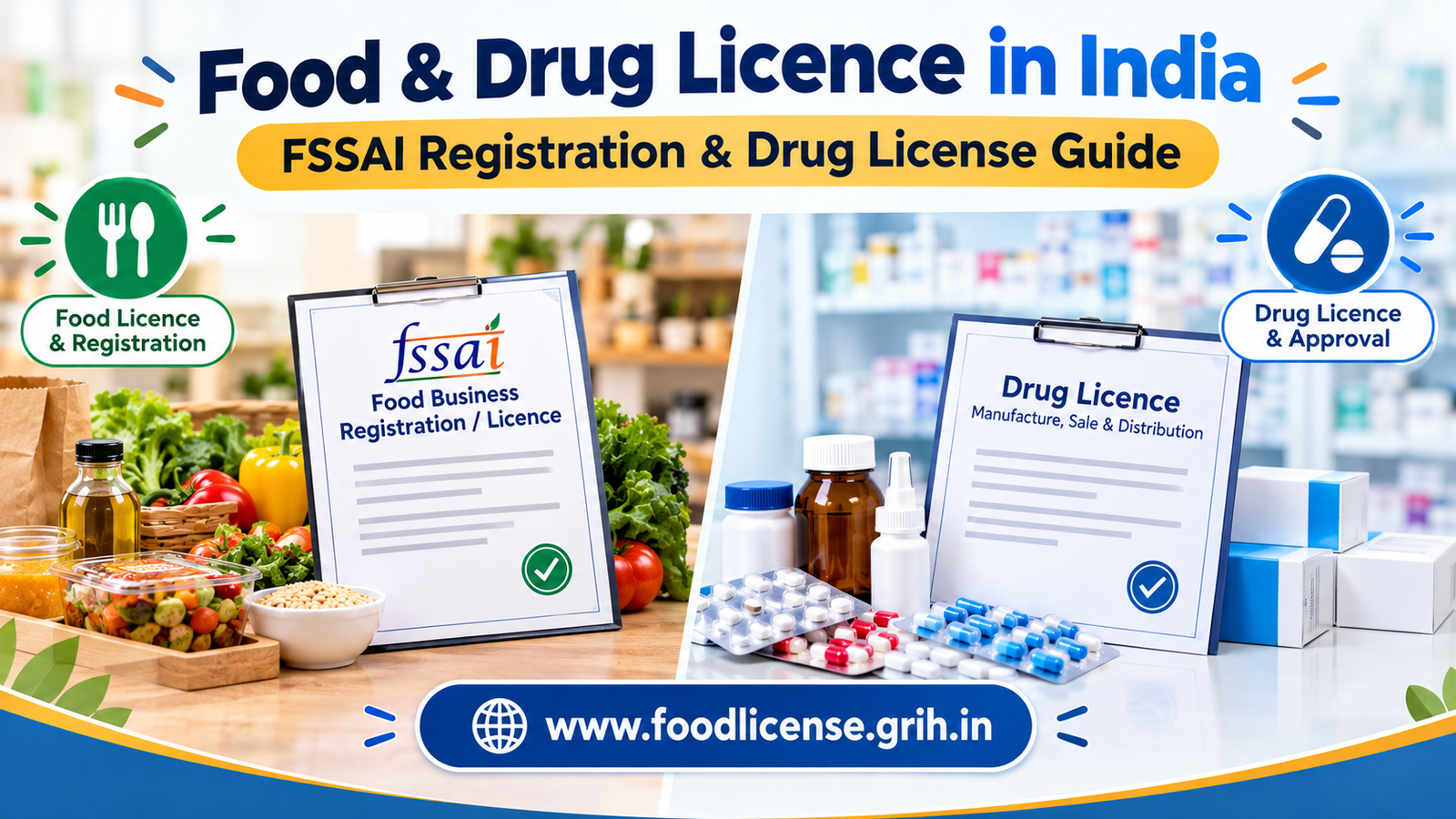
Food and Drug Licence in India: FSSAI Registration and Drug License Guide
A food and drug licence is an umbrella term commonly used for legal permissions required to operate a food business, pharmacy, medical store, drug wholesale business, medicine manufacturing unit, or related enterprise in India. However, food registration and drug licensing are governed by different laws, authorities, portals, and compliance requirements.
For food businesses, the applicable approval is generally an FSSAI Registration or FSSAI Licence. For medicine and pharmaceutical businesses, the requirement is usually a drug licence issued by the relevant State Drug Control Department under the Drugs and Cosmetics framework. Do not confuse Indian food and drug licences with U.S. FDA registration: the US Food and Drug Administration (US FDA) regulates products entering or sold in the United States, while FSSAI and Indian drug-control authorities regulate domestic Indian compliance.cdsco+1
Food and Drug Licence Meaning
A food and drug licence means the statutory approval needed to legally handle regulated food or drug products. In practical terms, it may refer to one or both of the following:
-
Food registration or FSSAI licence for restaurants, home kitchens, food manufacturers, online food sellers, caterers, bakeries, cloud kitchens, distributors, importers, and packaged-food brands.
-
Drug licence for pharmacies, chemists, medical stores, wholesalers, drug distributors, pharmaceutical manufacturers, and certain cosmetics businesses.
The food segment is governed by the Food Safety and Standards Act, 2006, and administered by the Food Safety and Standards Authority of India (FSSAI). The drug segment operates under the Drugs and Cosmetics Act, 1940 and Drugs Rules, 1945, with central oversight from the Central Drugs Standard Control Organisation (CDSCO) and licensing functions performed by State Governments and State Drug Control Departments.cdsco+1
A business selling only food normally needs FSSAI approval, not a drug licence. A medical store selling only medicines normally needs a drug sale licence, not an FSSAI licence. But a business dealing in both regulated foods and pharmaceutical products may need separate approvals.
Food Registration for Food Businesses
Food registration is mandatory for Food Business Operators (FBOs) in India. An FBO includes a person or entity involved in manufacturing, processing, packaging, storage, distribution, transportation, sale, or import of food.
Examples include:
-
Home-based bakers and tiffin services
-
Tea stalls, juice shops, sweet shops, and snack vendors
-
Restaurants, dhabas, cafés, and cloud kitchens
-
Grocery stores and supermarkets
-
Food manufacturers and repackers
-
Online food sellers and marketplace brands
-
Caterers and event-food suppliers
-
Warehouses, cold-storage operators, distributors, and transporters
-
Food importers and exporters
Since 1 April 2026, FSSAI has revised the turnover-based categories for many food businesses:
| Food registration category | Annual turnover threshold | Typical applicant |
|---|---|---|
| FSSAI Registration | Up to ₹1.5 crore | Small food seller, home kitchen, petty food business |
| State FSSAI Licence | Above ₹1.5 crore to ₹50 crore | Restaurant chain, manufacturer, distributor, medium food business |
| Central FSSAI Licence | Above ₹50 crore | Large food business, subject to applicable business criteria |
FSSAI also uses specific eligibility criteria for certain categories, including dairy units, slaughterhouses, food transporters, importers, exporters, and businesses operating in more than one state. Therefore, turnover is important but is not the only factor when choosing an FSSAI licence.fssai+1
Food and Drug Licence Difference
The term “food and drug licence” can create confusion because food approval and drug approval are not interchangeable. The following table explains the basic difference.
| Point | Food registration / FSSAI licence | Drug licence |
|---|---|---|
| Main regulator | FSSAI | State Drug Control Department and CDSCO framework |
| Main law | Food Safety and Standards Act, 2006 | Drugs and Cosmetics Act, 1940 and Drugs Rules, 1945 |
| Covers | Food, beverages, ingredients, packaged foods, food services | Medicines, pharmaceutical products, certain cosmetics |
| Common applicants | Food vendors, restaurants, manufacturers, importers | Pharmacies, wholesalers, distributors, manufacturers |
| Main application platform | FoSCoS | State drug-control portal or relevant state licensing authority |
| Key focus | Food safety, hygiene, labelling, storage, quality | Qualified staff, premises, storage, product control, sale/manufacture compliance |
Every Food Business Operator in India must obtain the appropriate FSSAI registration or licence. Meanwhile, the Drugs Rules provide for licensing authorities appointed by state governments for sale, stocking, distribution, and other regulated drug activities.fssai+1
Food and Drug Administration in India
The phrase Food and Drug Administration is often searched by people looking for the government department that regulates food and medicines. In India, the structure differs from the US Food and Drug Administration.
For food, the central regulator is FSSAI. It sets food-safety standards, oversees licensing and registration, regulates labelling, and supports enforcement through state and local food-safety authorities.
For drugs, CDSCO functions under the Ministry of Health and Family Welfare and is responsible for functions including drug approvals, clinical trials, standards, and regulation at the central level. State Drug Controllers and state licensing authorities manage many operational licensing matters, including retail and wholesale drug licences.
Some states use the name Food and Drug Administration or Food Safety and Drug Administration for their departments. For example, the Uttar Pradesh Food Safety and Drug Administration provides food licensing and drug/cosmetics application services through its official department portal.
Food and Drug Licence Types
A food and drug licence can include several distinct approvals depending on the business model.
Food and Drug Licence: FSSAI Registration
FSSAI Registration is generally intended for small food businesses. It is suitable for petty manufacturers, small retailers, hawkers, temporary stalls, home-based food ventures, and other small operators that meet the eligibility criteria.
Under the revised 2026 classification, businesses with annual turnover up to ₹1.5 crore fall under FSSAI Registration for the relevant categories.fssai
Food and Drug Licence: State FSSAI Licence
A State FSSAI Licence usually applies to eligible medium-sized food businesses operating within a state. This can include restaurants, food manufacturers, warehouses, distributors, caterers, and retailers whose operations exceed registration-level limits but do not require a Central Licence.
Food and Drug Licence: Central FSSAI Licence
A Central FSSAI Licence may be necessary for large food businesses, importers, exporters, businesses supplying government departments, operators working across multiple states, and specific categories defined by FSSAI eligibility conditions.
Food and Drug Licence: Retail Drug Licence
A retail drug licence is needed to sell medicines directly to consumers through a pharmacy, chemist shop, or medical store. The applicant must comply with applicable premises, storage, and competent-person requirements prescribed under the Drugs Rules and state-level procedures.
Food and Drug Licence: Wholesale Drug Licence
A wholesale drug licence is relevant for businesses that stock and distribute medicines to retailers, hospitals, pharmacies, or other authorised buyers rather than selling directly to end consumers.
Food and Drug Licence: Drug Manufacturing Licence
A drug manufacturing licence is required for businesses manufacturing pharmaceutical products. This category involves significantly more detailed technical, quality-control, facility, documentation, and inspection requirements than a retail or wholesale sale licence.
Food Registration Documents Required
Food registration documents vary according to the FSSAI category and nature of the business. Common documents may include:
-
Passport-size photograph of the applicant
-
Aadhaar card, PAN card, or other identity proof
-
Address proof of the proprietor, partners, or directors
-
Proof of business premises, such as rent agreement, ownership proof, or utility bill
-
Food product list or food-category details
-
Partnership deed, certificate of incorporation, or business constitution document
-
Layout plan of the processing or manufacturing unit, where applicable
-
List of machinery and equipment for manufacturing units
-
Water-analysis report where required
-
Food-safety management system plan or declaration, where applicable
-
Import Export Code for food importers or exporters, where applicable
Apply only through the official FoSCoS portal or use qualified professional support that gives you transparent access to your own application credentials and documents. FSSAI identifies FoSCoS as its official Food Safety Compliance System.foscos.fssai+1
Food and Drug Licence Application Process
The food and drug licence process should begin by identifying the exact activity of the business. Applying for the wrong category can delay approval, lead to modification requirements, or create compliance gaps.
For food registration, follow these steps:
-
Identify whether you need FSSAI Registration, State FSSAI Licence, or Central FSSAI Licence.
-
Check the applicable business category, turnover threshold, production capacity, and location criteria.
-
Create an account on the official FoSCoS portal.
-
Complete the applicable application form and upload the required documents.
-
Pay the prescribed government fee.
-
Respond promptly if the authority seeks clarification or additional documents.
-
Cooperate with inspection requirements, where applicable.
-
Download and display the issued FSSAI certificate at the business premises.
For drug licensing, the broad process is different:
-
Determine whether the business needs a retail, wholesale, manufacturing, loan, or other drug licence.
-
Apply to the competent state licensing authority or through the applicable state portal.
-
Upload ownership, premises, technical-person, storage, and business documents.
-
Ensure qualified personnel and storage arrangements meet the relevant requirements.
-
Facilitate inspection by the Drug Inspector or authorised official.
-
Receive the licence only after the licensing authority is satisfied with compliance.
Do not start selling prescription medicines merely because you have applied for a licence. Operating conditions, approvals, and state-level requirements must be met before commencing the regulated activity.
Food and Drug Licence Compliance
Obtaining a food and drug licence is only the first stage. Continuous compliance is essential.
For food businesses, compliance commonly includes:
-
Maintaining hygienic premises and safe water arrangements
-
Preventing contamination during preparation, storage, and transport
-
Using accurate food labels and ingredient declarations
-
Maintaining bills, supplier records, and traceability records
-
Displaying the FSSAI licence or registration number as required
-
Avoiding misleading health, therapeutic, or disease-cure claims
-
Renewing, modifying, or updating approvals when required under the applicable regulatory system
For drug businesses, compliance commonly includes:
-
Selling medicines only through authorised channels
-
Maintaining required storage conditions, including refrigeration where applicable
-
Keeping purchase and sale records
-
Employing required competent technical personnel
-
Following prescription, labelling, batch, expiry, and stock-control requirements
-
Avoiding sale of spurious, expired, misbranded, or improperly stored medicines
A food business should not market a normal food product as a treatment for diabetes, thyroid disorders, sexual conditions, cancer, or other diseases unless the claim is specifically permitted under applicable law. Similarly, supplements, nutraceuticals, and medicines are not automatically governed by the same licence category.
Food and Drug Licence FAQs
Food and Drug Licence: What is it?
A food and drug licence is a general term used for approvals connected with food and pharmaceutical businesses. In India, food businesses usually need FSSAI Registration or an FSSAI Licence, while medicine businesses need the appropriate drug licence from the competent state authority.
Food Registration: Is FSSAI mandatory?
Yes. FSSAI states that every Food Business Operator in India must be licensed or registered under the Food Safety and Standards Act, 2006. FSSAI registration guidancefssai
Food and Drug Licence: Do I need both approvals?
You need both only if your business genuinely handles both regulated food products and regulated drugs. A bakery usually needs FSSAI approval; a pharmacy usually needs a drug sale licence.
Food Registration: Which FSSAI category applies to small businesses?
For applications made under the revised thresholds effective from 1 April 2026, FSSAI Registration generally applies up to ₹1.5 crore annual turnover, subject to the applicable business category and eligibility conditions. FSSAI revised threshold FAQfssai
Food and Drug Licence: Can a home baker apply for FSSAI Registration?
Yes, a home baker or home-based food seller may apply for the applicable FSSAI Registration or Licence based on the business category, turnover, and operational details.
Food and Drug Administration: Is FSSAI the same as US FDA?
No. FSSAI regulates food safety in India. The US Food and Drug Administration is a U.S. federal agency that regulates products in the United States.fssai+1
Food and Drug Licence: Where can I apply for FSSAI?
Apply through the official FoSCoS portal. It is FSSAI’s online system for licensing and registration services.foscos.fssai
Food Registration: What documents are required?
Common documents include identity proof, address proof, premises proof, business details, product list, and category-specific documents. Manufacturing, importing, dairy, meat, and other specialised businesses may need additional documentation.
Food and Drug Licence: Can I sell medicines with only an FSSAI licence?
No. An FSSAI licence does not authorise the sale of medicines. A pharmacy or medicine seller requires the appropriate drug licence under the applicable drug-control framework.
Food and Drug Licence: Who issues a drug licence?
Drug licences are generally issued by the competent state licensing authority or State Drug Control Department, while CDSCO performs central regulatory functions under the Drugs and Cosmetics framework. CDSCO official websitecdsco
Food and Drug Licence: Is a pharmacist required for a medical store?
Retail drug licensing involves requirements relating to competent technical personnel, premises, and storage. The exact eligibility should be checked with the relevant State Drug Control Department because requirements and procedures can vary by licence type and state.
Food Registration: How long is an FSSAI licence valid?
FSSAI’s 2026 FAQ states that licences and registrations issued under the revised framework have perpetual validity unless they are suspended, cancelled, or surrendered. Existing businesses should check their FoSCoS account and official notices for migration or transition instructions.fssai
Food and Drug Licence: Can I use the word “FDA approved” on my food label?
Do not use “FDA approved” casually or misleadingly. In particular, U.S. FDA food-facility registration does not mean FDA has approved a facility’s products, labels, or claims.ecfr+1
Food and Drug Administration Registration: Is US FDA registration required for Indian food exports?
It may be required for facilities that manufacture, process, pack, or hold food intended for U.S. consumption, unless an exemption applies. Foreign facilities typically need a U.S. agent. FDA food-facility registration pagefda
Food and Drug Licence: Can I apply without a physical shop?
A food business may operate from a home or commercial kitchen if it meets applicable FSSAI requirements. A drug licence, however, has separate premises, storage, and personnel requirements; an online medicine business cannot assume that a standard home setup qualifies.
Food Registration: What happens if I operate without FSSAI approval?
Operating a food business without the applicable registration or licence can expose the business to enforcement action and may also create problems with marketplaces, delivery platforms, distributors, customers, and inspections.
Food and Drug Licence: How do I check official updates?
Use official portals rather than relying only on agents or unofficial blogs: FSSAI, FoSCoS, CDSCO, and the relevant State Food Safety or Drug Control Department.
1. क्या रजिस्ट्रेशन सालाना नवीकरण होता है?
2. क्या बिना GST नंबर के MSME पंजीकरण हो सकता है?
3. 12 अंकों का एमएसएमई पंजीकरण नंबर क्या है?
4. MSME प्रमाणपत्र क्या है?
5. MSME के अंतर्गत कौन-कौन से उद्योग आते हैं?
6. MSME के लिए कौन पात्र है?
- How to register on GeM portal
- GeM पोर्टल हेल्पलाइन नंबर 2026| कस्टमर केयर, ईमेल | टेंडर सहायता
- GeM पोर्टल क्या है | रजिस्ट्रेशन प्रोसेस, फायदे | सरकारी ऑर्डर पाने का तरीका (2026)
- एमएसएमई पंजीकरण 2026 | प्रक्रिया, लाभ, दस्तावेज़ | Udyam Guide
- जेम लॉगिन: GeM Login और रजिस्ट्रेशन की पूरी जानकारी

