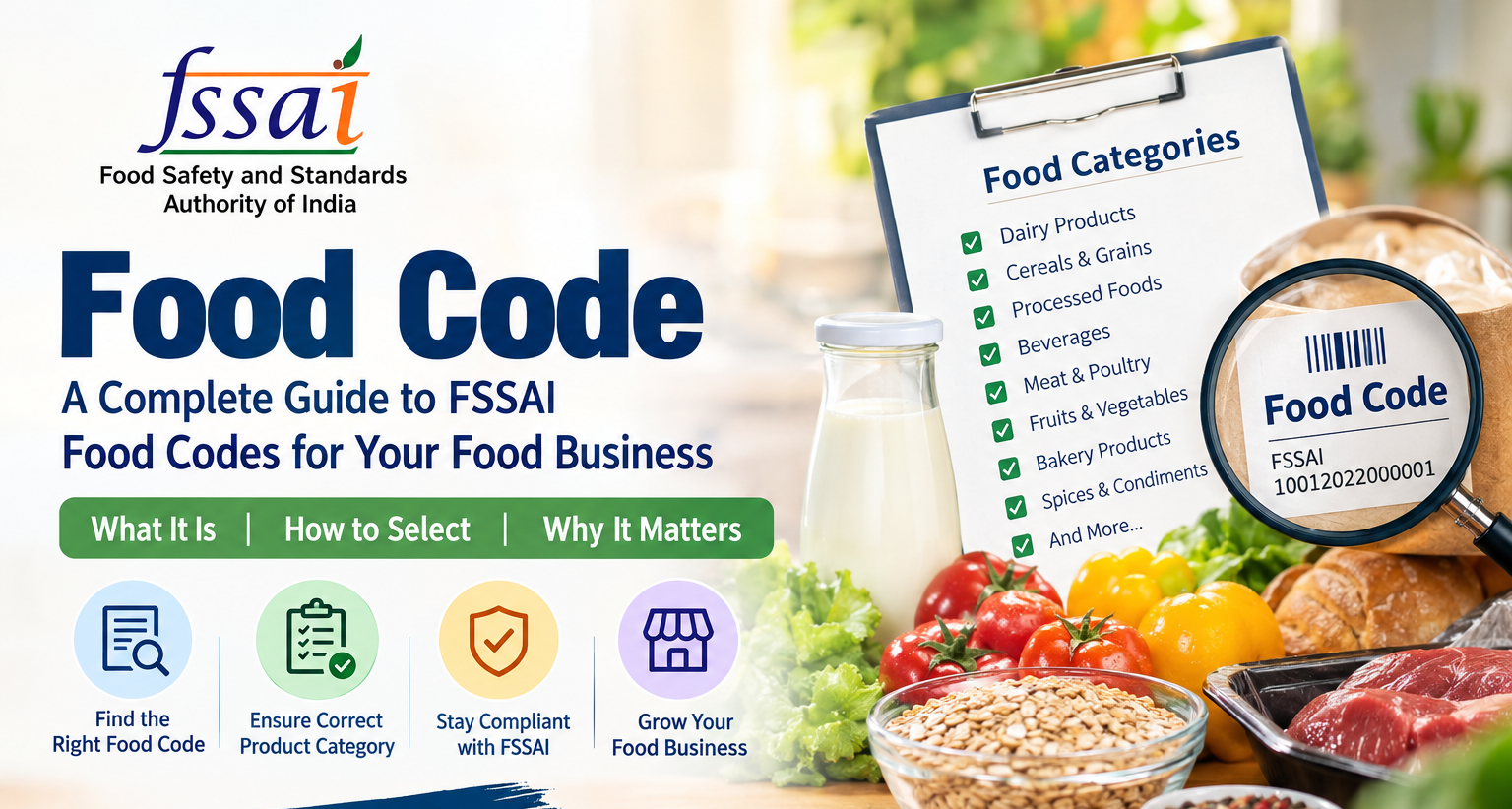
Food Code: FSSAI License, Registration and Renewal Online
Food Code is the foundation of food safety compliance in India. If you run a food business—whether a small home bakery, tea stall, restaurant, cloud kitchen, grocery shop, food manufacturer, or online seller on Swiggy and Zomato—you must understand the FSSAI registration and FSSAI licence system.
The Food Safety and Standards Authority of India (FSSAI) regulates food businesses under the FSSAI Act, officially called the Food Safety and Standards Act, 2006. Every Food Business Operator (FBO) is required to obtain either FSSAI basic registration, an FSSAI state licence, or an FSSAI central licence, depending on business size, turnover, and operations.
This complete guide explains food licence apply, FSSAI registration online, FSSAI renewal, FSSAI license cost, documents, eligibility, and how to apply for an online food licence through the official FSSAI portal.
Food Code and FSSAI: What Is FSSAI?
Food Code compliance begins with knowing what FSSAI actually means. FSSAI stands for the Food Safety and Standards Authority of India. It is the national authority responsible for protecting public health through regulation and supervision of food safety.
The official FSSAI website is www.fssai.gov.in, while food businesses apply, renew, modify, and manage licences through the FSSAI portal, known as FoSCoS—the Food Safety Compliance System—at foscos.fssai.gov.in.
FSSAI ensures that food sold in India is safe, hygienic, properly labelled, and free from adulteration. It also issues the FSSAI licence no., a 14-digit registration or licence number that must be printed on food products, packaging, bills, menus, and business documents.
Food Licence: Why Your Food Business Needs FSSAI Registration
A food licence is not optional for most food businesses. Under Section 31(1) and 31(2) of the FSS Act, 2006, every Food Business Operator in India must be licensed or registered with FSSAI.
You need FSSAI registration or a food safety licence if you operate any of the following:
-
Restaurant, café, dhaba, hotel, or cloud kitchen
-
Home-based food business or home bakery
-
Food stall, canteen, tiffin service, or catering business
-
Grocery store, kirana shop, or food retailer
-
Food manufacturer, processor, packer, or repacker
-
Wholesaler, distributor, transporter, or food storage unit
-
Online food seller on Swiggy, Zomato, Amazon, Flipkart, or ONDC
-
Importer or exporter of food products
-
Milk, meat, bakery, snacks, spices, or packaged food business
An FSSAI licence builds customer trust, helps you meet legal requirements, and is often mandatory for marketplace onboarding, bank loans, tenders, and brand partnerships.
FSSAI Registration: Basic, State and Central Licence Types
FSSAI registration is divided into three main categories. Choosing the correct category is important because applying under the wrong licence type can lead to rejection or future compliance issues.
|
Licence Type |
Who Should Apply |
Annual Turnover / Business Scale |
Government Fee |
|---|---|---|---|
|
FSSAI Basic Registration |
Petty food manufacturers, small retailers, hawkers, temporary stall holders, cottage-scale businesses |
Up to ₹12 lakh annually |
₹100 per year fssai.gov+1 |
|
FSSAI State Licence |
Medium-sized manufacturers, storage units, transporters, marketers, restaurants and food businesses within a state |
Above ₹12 lakh and within state-level limits |
Generally ₹2,000–₹5,000 per year, depending on category |
|
FSSAI Central Licence |
Large manufacturers, importers, exporters, businesses operating in multiple states, and businesses covered under central licensing |
Large-scale operations |
₹7,500 per year |
Food Safety Registration: FSSAI Basic Registration
Food safety registration under the Basic category is meant for small food businesses. It is also called basic FSSAI registration or FSSAI basic licence.
You should apply for FSSAI basic registration if your annual turnover is up to ₹12 lakh. Examples include small home bakers, petty retailers, small snack makers, tea stalls, and local food vendors.
For Basic Registration, the application is submitted in Form A, and the government fee is ₹100 per year. You can choose validity from 1 to 5 years, so the total fee can be ₹100 to ₹500.
State License FSSAI: FSSAI State Licence
State license FSSAI is required for medium-sized food businesses whose operations are limited to one state and whose turnover exceeds ₹12 lakh.
A restaurant, medium manufacturer, cold storage, food transporter, distributor, or catering company may require an FSSAI state licence. The application is made in Form B along with self-attested documents and the applicable fee.
State licence fees vary by business category. For example, fees may differ for manufacturers, hotels, restaurants, transporters, and storage units. The FoSCoS fee structure confirms that State Licence fees are category-based, while Basic Registration is ₹100 per year and Central Licence is ₹7,500 per year.
FSSAI Central License: Who Needs It?
FSSAI central license is required for large food businesses and specific regulated activities, including:
-
Food importers and exporters
-
Large manufacturers with operations across states
-
Central government undertakings
-
Food businesses operating at airports, seaports, and railway premises
-
Large-scale food processing companies
-
Businesses covered under mandatory central licensing
The Central Licence fee is ₹7,500 per year for both new applications and renewals, according to the official FoSCoS fee structure.
FSSAI License Requirements: Documents You Need
FSSAI license requirements depend on whether you are applying for Basic Registration, State Licence, or Central Licence. However, most applicants need the following documents:
-
Passport-size photograph of the applicant
-
Photo ID proof: Aadhaar card, PAN card, voter ID, or driving licence
-
Address proof of the business premises
-
Rent agreement or ownership proof
-
Electricity bill or utility bill of the premises
-
Business registration proof, if available
-
List of food products to be manufactured or sold
-
Layout plan of the processing unit or premises
-
Water test report, where applicable
-
Partnership deed, Certificate of Incorporation, MOA/AOA, or LLP agreement, if applicable
-
List of equipment and machinery for manufacturers
-
Food safety management plan or declaration
-
Form A for Basic Registration or Form B for State/Central Licencefssai.gov+1
For FSSAI registration for home bakers, documents are usually simpler: identity proof, address proof, kitchen premises proof, product list, and a declaration. However, if the home bakery grows beyond the basic turnover limit, a State Licence may become necessary.
FSSAI Registration Online: How to Apply for FSSAI Licence
FSSAI registration online is completed through the FoSCoS portal. The official process is digital, and applicants can apply for a new FSSAI licence, renewal, modification, or duplicate copy online.
Food Licence Apply Online: Step-by-Step Process
Follow these steps for food licence apply online:
-
Visit the official FSSAI FoSCoS portal: https://foscos.fssai.gov.in.
-
Create an account using your mobile number, email ID, and OTP verification.
-
Log in to the FSSAI portal and select Licence/Registration.
-
Choose your business type: manufacturer, retailer, restaurant, transporter, importer, exporter, or other category.
-
Select the correct licence type: Basic Registration, State Licence, or Central Licence.
-
Fill in Form A for Basic Registration or Form B for State/Central Licence.
-
Enter business details, owner details, food category, premises address, and turnover.
-
Upload all required documents in the prescribed format.
-
Pay the FSSAI license cost online using UPI, debit card, credit card, or net banking.
-
Submit the application and download the acknowledgement receipt.
-
Track your FSSAI application status through the FoSCoS dashboard.
The FSSAI official website and FoSCoS portal are the correct platforms for www fssai gov in registration, FSSAI apply online, and food license online apply services.
FSSAI License Apply Online: Basic FSSAI Registration Process
FSSAI license apply online for Basic Registration is the simplest process. Small food businesses can usually complete it quickly if their documents are correct.
For basic FSSAI registration:
-
Fill Form A
-
Submit identity and address proof
-
Provide business premises details
-
Declare the food products handled
-
Pay ₹100 per year
-
Receive the registration certificate after approval
Once approved, you receive a basic FSSAI license with a 14-digit FSSAI number. This number should be displayed at your business premises and printed on food labels, invoices, and packaging.
FSSAI License for Restaurant: Complete Compliance Guide
FSSAI license for restaurant businesses is usually a State Licence, especially when annual turnover exceeds ₹12 lakh. A restaurant must maintain hygiene, food safety records, trained staff, clean premises, proper waste disposal, and safe storage practices.
For a restaurant, the FSSAI licence application generally requires:
-
Restaurant address and layout plan
-
Owner or partner identity proof
-
Rent agreement or ownership documents
-
List of food items served
-
Water testing report, if required
-
Kitchen equipment details
-
Declaration of food safety compliance
Restaurants must display the FSSAI licence no. prominently. Food delivery platforms may also ask for a valid FSSAI licence before listing the restaurant.
FSSAI License for Swiggy and Zomato: Online Seller Requirements
FSSAI license for Swiggy and FSSAI license for Zomato is mandatory for restaurants, cloud kitchens, and food sellers who want to list on these delivery platforms.
To register as a food partner on Swiggy or Zomato, you generally need:
-
Valid FSSAI licence or registration
-
GST registration, if applicable
-
Bank account details
-
PAN card
-
Restaurant menu and pricing details
-
Kitchen address and contact details
-
Food packaging and hygiene compliance
Your FSSAI licence no. must be valid and correctly uploaded on the platform. If your licence expires, your listing may be affected, so timely FSSAI license renewal is essential.
FSSAI License Cost: FSSAI License Price and Government Fees
FSSAI license cost depends on licence type and validity period. The official FoSCoS fee structure states that licences or certificates can be applied for a maximum period of 5 years.
|
Licence Type |
1-Year Government Fee |
5-Year Government Fee |
|---|---|---|
|
FSSAI Basic Registration |
₹100 |
₹500 |
|
FSSAI State Licence |
₹2,000–₹5,000, depending on category |
₹10,000–₹25,000, depending on category |
|
FSSAI Central Licence |
₹7,500 |
₹37,500 |
The Central Licence fee is clearly listed as ₹7,500 per year, while Basic Registration is ₹100 per year. State Licence fees vary according to the food business category.
Food license price may also include professional service charges if you take help from a consultant, CA, or compliance agency. However, the government fee itself is paid directly on the FSSAI portal.
FSSAI Renewal: Why Timely Renewal Is Important
FSSAI renewal is the process of extending the validity of your existing FSSAI registration or licence. An FSSAI licence is valid for 1 to 5 years, based on the validity period selected at the time of application.
If your food license renewal is delayed, your business may be considered non-compliant. Late renewal can attract a penalty of ₹100 per day after the permitted renewal window, in addition to the renewal fee.
The renewal window generally opens 120 days before expiry. However, FSSAI guidance also states that renewal should be applied for not later than 30 days before the expiry date; applying early is always safer.
FSSAI License Renewal Online: Step-by-Step Renewal Process
FSSAI license renewal online can be completed through the same FoSCoS portal used for new registration.
Food Licence Renewal Online: How to Renew FSSAI Licence
To complete food licence renewal online:
-
Visit foscos.fssai.gov.in.
-
Log in with your registered mobile number and OTP.
-
Open your dashboard and go to My Licenses/Registrations.
-
Select the licence that requires renewal.
-
Click Apply for Renewal.
-
Verify and update business details if required.
-
Choose the renewal period: 1 to 5 years.
-
Upload updated documents, if applicable.
-
Pay the renewal fee online.
-
Download the renewed FSSAI certificate after approval.
The official FoSCoS renewal guide confirms that applicants can renew through login and that a late fee of ₹100 per day applies after 90 days beyond the expiry period.
FSSAI Registration Renewal: Documents Required for Renewal
FSSAI registration renewal usually requires fewer documents than a new application, especially if your business details have not changed.
Common documents include:
-
Existing FSSAI registration or licence certificate
-
FSSAI licence number
-
Updated identity proof
-
Address proof
-
Business premises proof
-
Updated food product list
-
Turnover declaration
-
Food safety management documents, if applicable
-
Form A or Form B, depending on licence type
If you have changed your address, added new products, changed business structure, or expanded operations, you may need to update or modify your licence before renewal.
FSSAI License Renewal Cost: FSSAI Licence Cost After Expiry
FSSAI license renewal cost is the same as the applicable government fee for the chosen validity period. For example:
-
Basic Registration: ₹100 per year
-
State Licence: ₹2,000–₹5,000 per year, depending on category
-
Central Licence: ₹7,500 per year
If renewal is delayed beyond the allowed period, a late fee of ₹100 per day may be charged along with the renewal fee.foscos.fssai.gov+1
Therefore, FSSAI licence renewal online should be completed before expiry to avoid penalties and business disruption.
FSSAI License Near Me: How to Find Local FSSAI Support
Many people search for FSSAI license near me or FSSAI registration near me when they need local help. However, FSSAI applications are submitted online through FoSCoS, not by visiting a local office in most cases.
You can get local support from:
-
FSSAI-empanelled consultants
-
Chartered Accountants
-
Company secretaries
-
Food safety consultants
-
Legal compliance agencies
-
MSME/Udyam service centres
Always verify that the consultant uses the official FSSAI portal and provides you with the application acknowledgement, login credentials, and final certificate.
FSSAI License for Home Bakers: Simple Registration Guide
FSSAI registration for home bakers is one of the most common requirements for small food entrepreneurs. If you bake cakes, cookies, bread, brownies, or snacks from home and sell them locally or online, you should obtain FSSAI registration.
For a small home bakery:
-
Apply for FSSAI basic registration if turnover is up to ₹12 lakh
-
Use Form A
-
Pay ₹100 per year
-
Maintain hygienic kitchen practices
-
Mention the FSSAI number on packaging or invoices
-
Upgrade to a State Licence if turnover or scale increases
Home bakers selling through Instagram, WhatsApp, Swiggy, Zomato, or local stores should keep their FSSAI certificate ready because platforms and customers may ask for proof of food safety compliance.
FSSAI License for Zomato: Cloud Kitchen and Restaurant Listing
FSSAI license for Zomato is required for restaurants, cloud kitchens, tiffin services, and home-based food sellers who want to receive online orders.
Zomato and Swiggy generally verify:
-
FSSAI licence validity
-
Business name match
-
Kitchen address
-
Food category
-
Licence expiry date
-
Owner or business details
If your FSSAI licence is expired or incorrect, your listing can be delayed or removed. Therefore, restaurants should track expiry dates and complete FSSAI food license renewal on time.
FSSAI Act: Legal Basis of Food Licensing in India
The FSSAI Act refers to the Food Safety and Standards Act, 2006. This law empowers FSSAI to regulate the manufacture, storage, distribution, sale, and import of food products in India.
Under the Act:
-
Every food business must be registered or licensed
-
Food businesses must follow hygiene and safety standards
-
Food labels must display correct information
-
Misbranded, unsafe, or adulterated food is prohibited
-
FSSAI can inspect, sample, and take action against violators
-
Food business operators must maintain records and compliance
The licensing and registration process is governed by the Food Safety and Standards (Licensing and Registration of Food Business) Regulations, 2011.fssai.gov+1
FSSAI Website: Official Portals for Food Licence
The FSSAI website has two important addresses:
-
www.fssai.gov.in — Official FSSAI website for laws, notifications, guidance, and food safety information
-
foscos.fssai.gov.in — FoSCoS portal for FSSAI registration, licence application, renewal, modification, and compliance
Avoid unofficial websites that promise instant FSSAI licences. Always use the official FSSAI portal for food license online, FSSAI online application, and FSSAI gov in registration services.fssai.gov+1
FSSAI Portal: How to Track FSSAI Application Status
After submitting your FSSAI application, you can track its status on the FSSAI portal.
To check status:
-
Log in to FoSCoS.
-
Open your dashboard.
-
Go to Track Application or My Applications.
-
Enter your application reference number, if required.
-
Check whether the application is under review, query raised, approved, or rejected.
If FSSAI raises a query, respond quickly with correct documents. Delays in responding can delay licence approval.
FSSAI License and Registration: Common Mistakes to Avoid
Many applications are delayed because of avoidable errors. When applying for FSSAI license and registration, avoid these mistakes:
-
Selecting the wrong licence category
-
Entering an incorrect annual turnover
-
Uploading blurred or incomplete documents
-
Using a different business name across documents
-
Not mentioning all food products correctly
-
Ignoring renewal reminders
-
Applying for Basic Registration despite turnover above ₹12 lakh
-
Not displaying the FSSAI number on packaging or premises
-
Missing FSSAI queries after submission
-
Waiting until the last date for renewal
Correct documentation and timely renewal are essential for smooth food licensing registration.
Food Safety Licence Apply: Benefits of FSSAI Licence
When you complete food safety licence apply correctly, your business receives several benefits:
-
Legal permission to operate a food business
-
Improved customer trust
-
Eligibility for Swiggy, Zomato, Amazon, and other platforms
-
Better chances of getting loans and tenders
-
Stronger brand credibility
-
Compliance with Indian food safety laws
-
Protection from penalties and business closure risks
-
Ability to expand into packaged food, exports, or multi-state operations
An FSSAI licence is especially valuable for small businesses because it signals that the food is prepared and sold under approved safety standards.
ISO for Food: Is ISO Certification the Same as FSSAI?
Many business owners search for ISO for food along with FSSAI. However, ISO certification and FSSAI licensing are different.
|
Aspect |
FSSAI Licence |
ISO Certification |
|---|---|---|
|
Legal requirement |
Mandatory for most food businesses in India |
Usually voluntary |
|
Issuing authority |
Food Safety and Standards Authority of India |
ISO certification bodies |
|
Purpose |
Legal food safety compliance |
Quality management and process improvement |
|
Required for |
Restaurants, manufacturers, sellers, importers, etc. |
Businesses seeking quality certification |
|
Certificate number |
14-digit FSSAI number |
ISO certificate number |
FSSAI is the legal requirement. ISO certification, such as ISO 22000 for food safety management, can be an additional quality credential but does not replace an FSSAI licence.
Food License and Registration: Frequently Asked Questions
1. What is the difference between FSSAI registration and FSSAI licence?
FSSAI registration is for small food businesses with turnover up to ₹12 lakh. An FSSAI licence—State or Central—is required for larger businesses. Basic Registration uses Form A, while State and Central Licences use Form B.fssai.gov+1
2. How much does an FSSAI licence cost?
Basic Registration costs ₹100 per year. State Licence fees generally range from ₹2,000 to ₹5,000 per year depending on the category. Central Licence costs ₹7,500 per year.foscos.fssai.gov
3. How long is an FSSAI licence valid?
An FSSAI registration or licence is valid for 1 to 5 years, depending on the period selected by the food business operator.foscos.fssai.gov
4. Can I renew an expired FSSAI licence?
Yes. FSSAI allows renewal after expiry in specified cases, but a late fee of ₹100 per day may apply. It is best to renew before the expiry date.foscos.fssai.gov+1
5. Is FSSAI mandatory for a home food business?
Yes, if you sell food, even from home, you generally need FSSAI registration. Small home businesses with turnover up to ₹12 lakh can apply for Basic Registration.fssai.gov
6. Is FSSAI required for Swiggy and Zomato?
Yes. Restaurants, cloud kitchens, and food sellers need a valid FSSAI licence or registration to list and sell on Swiggy and Zomato.
7. Can I apply for FSSAI licence online?
Yes. You can complete FSSAI license online apply through the official FoSCoS portal at foscos.fssai.gov.in.foscos.fssai.gov
8. What is the FSSAI licence number?
The FSSAI licence number is a 14-digit number issued after approval. It must be displayed on food packages, labels, menus, invoices, and business premises.
Food Code Compliance: Final Checklist for Food Businesses
Before starting or expanding your food business, use this Food Code compliance checklist:
-
Identify whether you need Basic Registration, State Licence, or Central Licence
-
Apply through the official FoSCoS portal
-
Keep all identity, address, and business documents ready
-
Select the correct food category and business activity
-
Pay the correct government fee
-
Track your application regularly
-
Display your FSSAI number at your premises
-
Print the FSSAI number on labels, packaging, and invoices
-
Renew your licence before expiry
-
Maintain hygiene, storage, and food safety records
A valid FSSAI food licence is more than a legal formality—it is a trust signal for customers, delivery platforms, investors, and regulators. Whether you need FSSAI registration for home bakers, an FSSAI license for restaurant, an FSSAI license for Swiggy, or an FSSAI central license, start with the correct licence category and renew it on time.
1. क्या रजिस्ट्रेशन सालाना नवीकरण होता है?
2. क्या बिना GST नंबर के MSME पंजीकरण हो सकता है?
3. 12 अंकों का एमएसएमई पंजीकरण नंबर क्या है?
4. MSME प्रमाणपत्र क्या है?
5. MSME के अंतर्गत कौन-कौन से उद्योग आते हैं?
6. MSME के लिए कौन पात्र है?
- How to register on GeM portal
- GeM पोर्टल हेल्पलाइन नंबर 2026| कस्टमर केयर, ईमेल | टेंडर सहायता
- GeM पोर्टल क्या है | रजिस्ट्रेशन प्रोसेस, फायदे | सरकारी ऑर्डर पाने का तरीका (2026)
- एमएसएमई पंजीकरण 2026 | प्रक्रिया, लाभ, दस्तावेज़ | Udyam Guide
- जेम लॉगिन: GeM Login और रजिस्ट्रेशन की पूरी जानकारी

