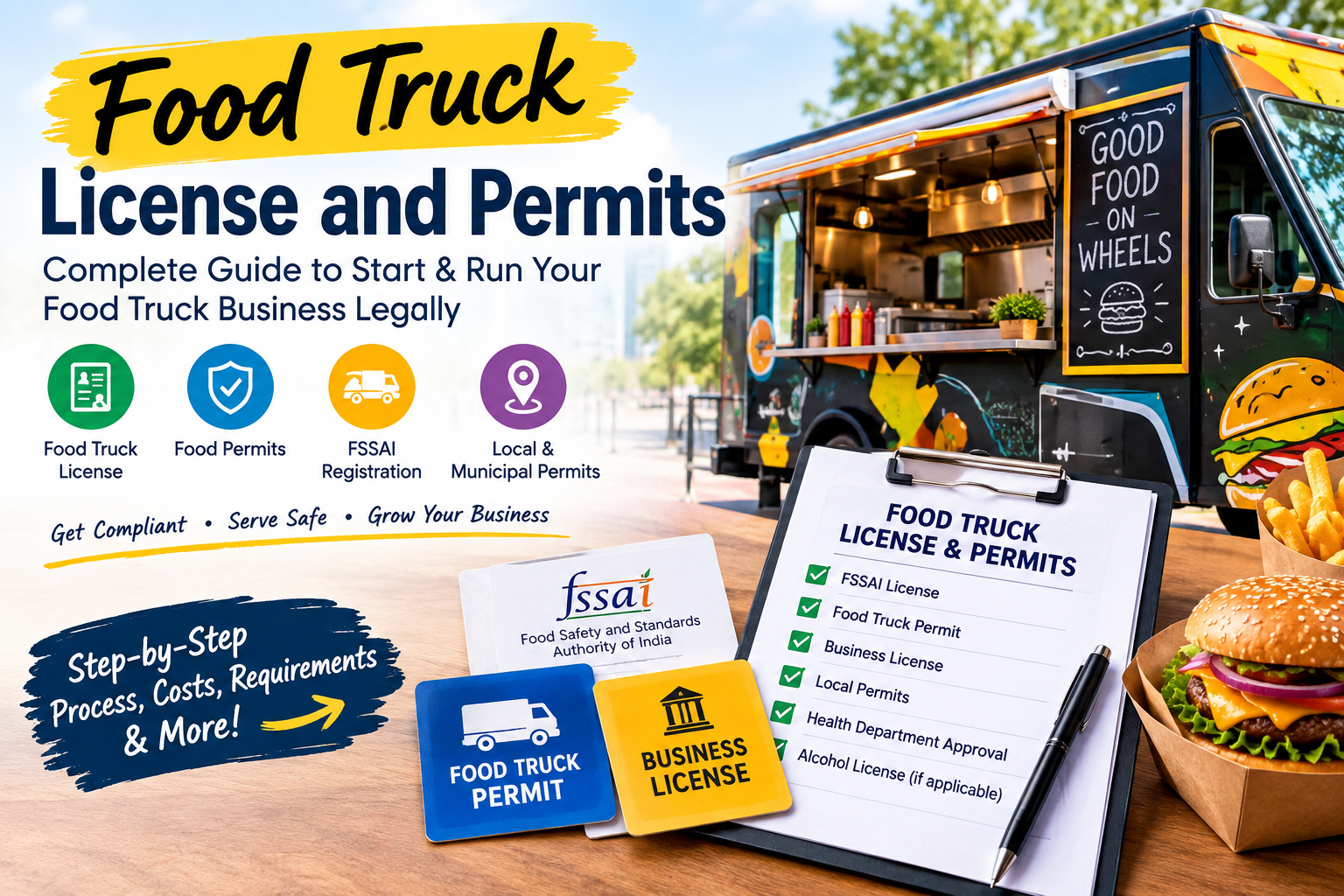
Food Truck License and Permits | Food Truck License | FSSAI License
Starting a food truck can be an attractive business opportunity for entrepreneurs who want to enter the food industry without investing in a traditional restaurant. However, food truck license and permits are important before beginning commercial operations. A food truck is still a food business, so the owner needs to comply with food-safety regulations as well as applicable municipal, vending, parking, vehicle, and other local requirements.
The exact requirements can vary from one city to another. A food truck operating on private property may have different permissions from one operating on a public road or designated vending zone. Similarly, a food truck selling only prepared food may have different requirements from one that also sells alcohol.
For this reason, understanding the food truck license, food truck permit, FSSAI requirements, local permissions, documentation, and potential costs is essential before investing in a food truck business.
Food Truck License: What Is It and Why Is It Required?
A food truck license is not necessarily a single universal license that covers every aspect of a mobile food business in India. Instead, a food truck may require multiple registrations, licenses, certificates, and permissions depending on its activities and location.
The most important food-safety approval is generally the applicable FSSAI registration or license. FSSAI regulates food businesses in India, while local authorities may regulate vending, trade, parking, public-space usage, and other activities.
Therefore, entrepreneurs should think of compliance as a combination of:
-
Food-safety approval
-
Municipal/local permission
-
Vending or location permission
-
Vehicle compliance
-
Fire-safety requirements, where applicable
-
GST registration, where applicable
-
Business registration
-
Excise/liquor permission, if alcohol is sold
Food Truck Permit: Understanding Local Permission
A food truck permit generally refers to permission from the relevant local authority allowing a mobile food business to operate in a particular area or under particular conditions.
Having an FSSAI registration or license does not automatically mean that a food truck can park and sell food anywhere. Local authorities can regulate where mobile vendors can operate.
A food truck owner may therefore need to check:
-
Municipal vending rules
-
Designated vending zones
-
Parking restrictions
-
Local trade permissions
-
Private-property permissions
-
Event permissions
-
Waste-disposal requirements
-
Fire-safety requirements
The exact process depends on the city and local authority.
Food Cart License: Requirements for Mobile Food Businesses
A food cart license may be relevant when food is sold through a movable cart, kiosk, stall, or similar setup rather than a motorized truck.
Food cart operators should distinguish between food-safety registration and local vending permission. The FSSAI requirement addresses food safety, while municipal or local authorities may regulate where and how the cart operates.
A small food cart may therefore need:
-
Applicable FSSAI registration/license
-
Local vending permission, where required
-
Municipal permission
-
Location or market authorization
-
Business registration, where applicable
-
Other permissions depending on the activity
Food License for Food Truck: FSSAI Registration and Licensing
A food license for food truck is primarily associated with FSSAI registration or licensing.
FSSAI's official guidance identifies a food truck under the Food Vending Establishment category for the relevant application. The application is made through the Food Safety Compliance System, commonly known as FoSCoS.
The type of FSSAI approval depends on factors such as the nature and scale of the food business and applicable eligibility conditions.
Food truck operators should provide accurate business information and select the appropriate food-business category while applying.
Food Truck Licence: Licence vs Registration
The terms food truck licence and food truck registration are often used interchangeably, but they can refer to different levels of FSSAI authorization.
For eligible small food businesses, FSSAI registration may apply. Businesses crossing the relevant threshold or falling into specified categories may require an FSSAI license.
Because FSSAI categories and requirements can change, applicants should verify the current criteria on FoSCoS before submitting an application.
Food Permits for Food Truck: Common Approvals You May Need
Food permits for food truck operations can come from different authorities.
Depending on the business model, a food truck may need:
1. FSSAI Registration or License
This addresses food-safety compliance.
2. Municipal Permission
Local municipal authorities may regulate commercial activities within their jurisdiction.
3. Vending Permission
If the food truck operates in a public vending area, additional permission may be required.
4. Parking or Location Permission
A food truck cannot automatically occupy public parking or road space for commercial activity.
5. Vehicle Documents
The truck must comply with applicable motor-vehicle requirements.
6. Fire-Safety Compliance
If cooking equipment, LPG, electrical systems, or other fire-related risks are involved, applicable fire-safety requirements should be checked.
7. GST Registration
GST registration may apply depending on turnover, business structure, and applicable GST rules.
8. Liquor License
A separate excise authorization may be required if alcoholic beverages are sold.
Food Van License: Requirements for a Food Van Business
A food van license may be relevant when food is prepared, stored, or sold from a van.
The requirements can depend on whether the vehicle is:
-
Used for food preparation
-
Used for food storage
-
Used for transportation
-
Used for direct food sales
-
Used for catering
-
Operated from public spaces
-
Operated from private property
A food van business should therefore review both food-safety and vehicle-related requirements.
Food Van Permit: Where Can a Food Van Operate?
A food van permit can be important when the vehicle operates from regulated public areas.
For example, permission may be needed for:
-
Designated vending zones
-
Markets
-
Events
-
Public spaces
-
Municipal areas
-
Private commercial premises
-
Festivals
Operating from private property may involve permission from the property owner, while public locations may involve municipal or other competent authorities.
FSSAI License for Food Truck: How to Apply
The FSSAI license for food truck application can be made through FoSCoS.
A general application process includes:
Step 1: Identify the applicable category
Select the appropriate food-business category based on your operations.
Step 2: Prepare documents
Common information may include identity details, business details, address information, food-business details, and other documents depending on the application.
Step 3: Submit the application
Complete the applicable online application and pay the prescribed fee.
Step 4: Verification
The application may be reviewed by the relevant authority, and inspection may apply where required.
Step 5: Receive the approval
Once approved, the applicable FSSAI registration certificate or license is issued.
Food businesses should display and maintain their FSSAI details as required.
License for Food Stall: Is It Different from a Food Truck?
A license for food stall can involve similar food-safety requirements but may have different local permissions.
A temporary food stall at an exhibition, festival, or event may require event-specific authorization.
A permanent or semi-permanent stall may have different municipal and property-related requirements.
Therefore, food stall operators should determine:
-
Where the stall will operate
-
Whether it is temporary or permanent
-
What food will be sold
-
Whether food will be prepared onsite
-
Whether public land is involved
-
Whether the activity occurs at an organized event
Licenses and Permits for a Food Truck: Complete Checklist
Licenses and permits for a food truck can be organized into several categories.
|
Approval |
Purpose |
|---|---|
|
FSSAI Registration/License |
Food safety |
|
Municipal Permission |
Local business activity |
|
Vending Permission |
Public vending |
|
Parking/Location Permission |
Operating location |
|
Vehicle Documents |
Vehicle compliance |
|
Fire Compliance |
Safety where applicable |
|
GST Registration |
Tax compliance where applicable |
|
Business Registration |
Legal business structure |
|
Liquor License |
Alcohol sales |
|
Event Permission |
Temporary/event operations |
Not every food truck will need every approval. Requirements depend on the business model and location.
Taco Truck License: Does Food Type Change the License?
A taco truck license is not necessarily a separate national license simply because tacos are being sold.
Instead, the business generally needs the applicable food-business registration/license and local permissions.
The same principle can apply to:
-
Burger trucks
-
Pizza trucks
-
Coffee trucks
-
Dessert trucks
-
Ice cream trucks
-
South Indian food trucks
-
Chinese food trucks
-
Snack carts
The food menu can affect food-safety considerations, but the business should focus on obtaining the appropriate underlying approvals.
Starting a Food Truck Business: Legal Setup
Starting a food truck business requires planning beyond purchasing a vehicle.
Before launching, consider:
-
Business structure
-
Food menu
-
Kitchen design
-
Vehicle selection
-
Food-safety requirements
-
Operating location
-
Local vending rules
-
Parking arrangements
-
Waste management
-
Fire safety
-
Employee/food-handler practices
-
Tax requirements
A well-planned compliance structure can help reduce problems after launch.
Business License for Food Truck: Local Compliance
A business license for food truck may refer to a municipal trade or business permission.
The terminology differs between authorities. Some cities may use terms such as trade license, health trade license, vending permission, or municipal permission.
Therefore, food truck owners should check the terminology used by their particular municipal corporation.
Food Truck Permit Cost: How Much Does It Cost?
Food truck permit cost varies depending on the city, type of permission, business scale, and operating location.
Possible expenses include:
-
FSSAI government fee
-
Municipal fees
-
Vending fees
-
Parking/location fees
-
Event fees
-
Fire-safety expenses
-
Vehicle registration and compliance
-
GST/business compliance costs
-
Professional documentation fees
There is no single nationwide food truck license cost applicable to every food truck.
Entrepreneurs should calculate the total compliance cost only after identifying their city and business model.
Food Truck Certification: Food Safety and Hygiene
Food truck certification can refer to different forms of compliance depending on the context.
Food truck operators should pay particular attention to:
-
Food hygiene
-
Clean water
-
Food storage
-
Temperature control
-
Pest control
-
Personal hygiene
-
Waste disposal
-
Cleaning and sanitation
-
Safe cooking practices
Food handlers should also follow applicable hygiene and health requirements.
Mobile Food Vendor License: Requirements for Vendors
A mobile food vendor license can involve both food-safety and local vending requirements.
The entrepreneur should determine whether the business is classified as:
-
Mobile food vendor
-
Food vending establishment
-
Food cart
-
Food truck
-
Temporary food stall
-
Catering business
Correct classification can help determine which registrations and permissions are applicable.
Mobile Food Service License: Catering and Mobile Food Operations
A mobile food service license may become relevant for businesses that provide prepared food from mobile units or provide catering services.
For catering operations, requirements may differ depending on whether food is:
-
Prepared inside the vehicle
-
Prepared at a separate kitchen
-
Transported to an event
-
Served directly from the vehicle
The business should obtain the applicable FSSAI and local permissions based on its actual operation.
Food Truck Permit Requirements: Location Matters
Food truck permit requirements can vary significantly depending on the location.
A truck operating from a private commercial property may have a different permission structure from one using a public road.
Before finalizing a location, check:
-
Municipal regulations
-
Parking rules
-
Vending zones
-
Property permissions
-
Event permissions
-
Waste-management requirements
-
Fire-safety requirements
Food Truck License Cost: Factors That Affect Expenses
Food truck license cost depends on several factors.
Business size
A larger operation may require a different FSSAI category.
Location
Municipal and vending fees can vary.
Type of food
Different food operations can involve different compliance considerations.
Operating model
A permanent location, mobile route, private property, or event-based business may have different requirements.
Alcohol sales
Selling alcohol can introduce separate excise licensing and compliance costs.
Mobile Food Vendor Permit: Public-Space Operations
A mobile food vendor permit can be particularly relevant when selling food from public spaces.
Local authorities may designate specific vending areas and impose conditions related to:
-
Operating hours
-
Location
-
Hygiene
-
Waste disposal
-
Parking
-
Signage
-
Vendor identification
Food truck owners should not assume that obtaining FSSAI approval gives unlimited public-space vending rights.
Apply for Food Truck License: Basic Process
To apply for food truck license, first identify every authority relevant to your business.
A practical approach is:
First, identify the applicable FSSAI category.
Second, determine your municipal/local authority.
Third, confirm whether vending or parking permission is necessary.
Fourth, organize vehicle documents.
Fifth, check fire-safety requirements.
Sixth, determine whether GST or other business registrations apply.
Finally, check whether any special permissions are required for events, alcohol, or specific locations.
Food Trailer License: Requirements for Trailer Businesses
A food trailer license may be relevant when food is prepared or sold from a trailer rather than a motorized truck.
A trailer operator should consider:
-
Applicable FSSAI registration/license
-
Vehicle/trailer documentation
-
Local vending permission
-
Parking/location permission
-
Fire safety
-
Food hygiene
-
Waste management
A food trailer licence is therefore not necessarily one standalone document.
Food Truck Vendor License: Vendor Compliance
A food truck vendor license may refer to local authorization for operating as a mobile food vendor.
Requirements can depend on:
-
City
-
Municipality
-
Operating location
-
Business type
-
Vehicle
-
Food category
-
Public/private property
Always confirm the current rules with the applicable authority.
Food Stand License: Temporary and Permanent Food Stands
A food stand license can be relevant for stalls operating at markets, events, fairs, exhibitions, or commercial locations.
Temporary businesses should check whether an event organizer has obtained overarching permission or whether each food vendor must obtain separate approval.
Licenses Needed to Start a Food Truck: Final Compliance List
Licenses needed to start a food truck may include the following, depending on circumstances:
-
FSSAI registration/license
-
Municipal/trade permission
-
Street vending permission
-
Parking/location permission
-
Vehicle compliance
-
Fire-safety approval
-
GST registration
-
Business registration
-
Event permission
-
Liquor license
The actual list should be confirmed according to the city and business model.
BMC License for Food Truck: Mumbai-Specific Considerations
BMC license for food truck searches are particularly relevant to entrepreneurs planning to operate in Mumbai.
BMC-related requirements should be checked directly with the Brihanmumbai Municipal Corporation because municipal permissions, vending regulations, and local requirements can change.
Entrepreneurs should not assume that a permission applicable in Delhi, Bengaluru, Hyderabad, or another city automatically applies in Mumbai.
Food Cart Business License: Starting a Cart Business
A food cart business license can involve FSSAI compliance plus local vending authorization.
Before starting, determine:
-
Cart location
-
Food category
-
Business ownership
-
FSSAI requirement
-
Municipal permission
-
Vending-zone rules
-
Waste-disposal arrangements
Food Cart Business Permit: Public Vending Requirements
A food cart business permit may be necessary when operating in public spaces.
Local authorities may regulate the number and location of vendors, so entrepreneurs should check availability before purchasing equipment or paying for a long-term location.
Food Cart Business Permit Requirements: Documents
Food cart business permit requirements may include:
-
Identity proof
-
Address proof
-
Photograph
-
Business information
-
FSSAI details
-
Cart details
-
Location information
-
Supporting NOC or property permission
-
Other documents requested by the authority
Requirements differ by location.
Food Cart Business Registration: Important First Step
Food cart business registration can help establish the legal identity and structure of the business.
Depending on the business model, entrepreneurs may choose a proprietorship, partnership, LLP, company, or another suitable structure.
The registration requirement should be evaluated separately from food-safety and vending permissions.
Food Cart Permit Cost: What Should You Budget?
Food cart permit cost depends on the local authority and type of vending permission.
Potential expenses include municipal fees, FSSAI fees, location charges, documentation expenses, and other compliance costs.
Always verify the current official fee before making financial projections.
Food Cart Permits: Why Multiple Permissions May Apply
Food cart permits can cover different activities.
For example, one permission may regulate vending while another addresses food safety.
This is why entrepreneurs should create a compliance checklist rather than searching for one document called a “food cart license.”
Food Cart Vendor License: Operating Legally
A food cart vendor license may be required under local vending rules.
Operators should also ensure that their food business complies with FSSAI requirements and that the cart operates only in permitted locations.
Food Trailer Licence: Mobile Food Trailer Compliance
A food trailer licence may involve food-safety, vehicle, parking, and local business requirements.
Food trailer operators should check whether their trailer falls under specific local transport or commercial-use rules.
Food Truck Alcohol License: Selling Alcohol
A food truck alcohol license is separate from an FSSAI license.
If the business plans to sell beer, wine, spirits, or other alcoholic beverages, the entrepreneur must check the applicable state excise rules.
A liquor license for food truck may not be available under the same rules as a conventional restaurant because licensing can depend on premises and location.
Never begin alcohol sales without confirming the applicable authorization.
Mobile Food Truck License: Comprehensive Compliance
A mobile food truck license should be understood as a collection of approvals rather than assuming one certificate covers everything.
The entrepreneur should maintain copies of:
-
FSSAI certificate/license
-
Municipal permissions
-
Vending permissions
-
Vehicle documents
-
Fire-safety documents, where applicable
-
GST documents, where applicable
-
Event permissions, where applicable
-
Alcohol license, where applicable
Mobile Food Truck Permit: Operating at Different Locations
A mobile food truck permit may not automatically authorize operation across every city or municipal jurisdiction.
If a truck travels between cities, the owner should verify the applicable rules in each jurisdiction.
This is especially important for businesses using a traveling or multi-location business model.
Mobile Food Vendor Requirements: Hygiene and Compliance
Mobile food vendor requirements go beyond obtaining certificates.
Food vendors should maintain:
-
Clean preparation areas
-
Safe food storage
-
Proper handwashing facilities
-
Clean utensils
-
Safe water
-
Waste containers
-
Pest-control measures
-
Personal hygiene
-
Appropriate temperature control
Consistent hygiene is essential for protecting customers and maintaining compliance.
Mobile Vending License: Public Road and Market Rules
A mobile vending license may regulate where vendors can operate.
Local authorities may establish vending zones or impose restrictions on certain roads and public spaces.
Therefore, location research should be completed before investing in a food truck.
Permits for Food Vendors: Events and Temporary Operations
Permits for food vendors can be especially important for fairs, exhibitions, festivals, and temporary markets.
A temporary food truck permit may be required depending on the event and local rules.
Event organizers may also require vendors to submit:
-
FSSAI details
-
Business details
-
Menu
-
Identity information
-
Insurance or safety documentation
-
Local permissions
Health Department Food Truck Permit: Food Safety Checks
A health department food truck permit may refer to local health-related approval or inspection requirements.
Local authorities can inspect hygiene, food handling, storage, water supply, waste disposal, and other conditions depending on their jurisdiction.
Burger Van Licence: Food-Specific Mobile Business
A burger van licence is generally not a separate national license solely because the business sells burgers.
The operator should obtain the applicable FSSAI and local permissions.
The same approach applies to a burger van permit.
Ice Cream Truck Business License: Cold Food Vendors
An ice cream truck business license can involve FSSAI requirements, vehicle compliance, local vending permissions, and location restrictions.
Businesses should also maintain appropriate cold-chain and storage practices for frozen products.
Licence for Mobile Food Van: Final Requirements
A licence for mobile food van operations can involve multiple regulatory areas.
Before launch, confirm:
-
FSSAI authorization
-
Vehicle compliance
-
Local vending permission
-
Parking permission
-
Fire safety
-
Waste management
-
Tax registration, if applicable
Licence Required for Food Truck: Is One License Enough?
The licence required for food truck operations is not necessarily one single license.
A food truck can be subject to multiple laws and authorities.
The safest approach is to identify requirements based on:
Food safety + location + vehicle + business + local authority + special activities.
Licence to Sell Food From a Van: Food Safety
A licence to sell food from a van generally involves the applicable food-business registration or license along with local permissions.
The operator should not rely solely on vehicle registration because vehicle compliance and food-business compliance are separate matters.
License for Food Trailer: Trailer-Based Food Business
A license for food trailer operations can involve:
-
FSSAI approval
-
Local permission
-
Trailer/vehicle documentation
-
Parking/location authorization
-
Fire safety
-
Waste management
Requirements vary according to the jurisdiction and business model.
License for Ice Cream Truck: Mobile Frozen Food Business
A license for ice cream truck operations can require the applicable food-business authorization and local vending permissions.
Temperature-controlled storage should also be maintained to protect product quality and safety.
License for Mobile Food Vendor: Legal Operation
A license for mobile food vendor operations should be considered together with local vending rules.
The business should identify where it is legally permitted to operate before beginning sales.
License Needed for Food Truck: Key Takeaway
The license needed for food truck operations depends on the location, turnover, food activity, vehicle, and business model.
There is no universal checklist that works identically across all Indian cities.
License to Run a Food Truck: Practical Compliance Strategy
A license to run a food truck should be obtained before commercial operations wherever required.
A practical strategy is to maintain a compliance folder containing every registration, permission, certificate, renewal date, inspection document, and payment receipt.
Licenses Needed for a Food Truck: Complete Overview
Licenses needed for a food truck may include:
-
FSSAI registration/license
-
Municipal permission
-
Vending permission
-
Parking/location permission
-
Vehicle documentation
-
Fire-safety compliance
-
GST registration, if applicable
-
Business registration
-
Event permission
-
Liquor license, if applicable
Liquor License for a Food Truck: Alcohol Sales
A liquor license for a food truck is a state-specific issue.
Alcohol licensing is generally governed by state excise laws, and permission depends on the applicable license category and premises requirements.
Therefore, anyone planning food truck selling alcohol should contact the relevant state excise authority before launching that part of the business.
Mobile Food Business Licence: Long-Term Compliance
A mobile food business licence should be treated as part of an ongoing compliance process.
After obtaining licenses, businesses should monitor:
-
Expiry dates
-
Renewals
-
Address changes
-
Menu/business changes
-
Vehicle changes
-
Local permissions
-
Inspection requirements
Keeping licenses current is just as important as obtaining them initially.
Mobile Food Cart License: Small-Scale Vendors
A mobile food cart license can be relevant to small vendors operating from movable carts.
The applicable FSSAI registration/license should be determined based on the nature and scale of the food business.
Local vending requirements should be separately verified.
Mobile Food Cart Permit: Location Authorization
A mobile food cart permit may be necessary for operating in designated public vending areas.
A vendor should never assume that permission in one market or locality automatically permits operation elsewhere.
Mobile Food Licence: Food-Safety Compliance
A mobile food licence should be supported by proper hygiene practices.
Even after obtaining registration, food businesses remain responsible for complying with applicable food-safety requirements.
Mobile Food License: Business and Tax Compliance
A mobile food license is only one part of establishing a compliant business.
Entrepreneurs should also evaluate:
-
Business structure
-
GST
-
Accounting
-
Employee requirements
-
Local taxes/fees
-
Insurance
-
Vehicle compliance
Mobile Food Service Permit: Catering Operations
A mobile food service permit may be relevant to mobile catering operations.
Catering businesses should determine whether food is prepared in a central kitchen, transported to events, or prepared inside the mobile unit.
Obtaining a Food Truck License: Final Step-by-Step Guide
Obtaining a food truck license can be approached systematically:
-
Choose your food concept.
-
Decide your business structure.
-
Select the vehicle.
-
Identify your operating locations.
-
Determine the applicable FSSAI category.
-
Apply for FSSAI registration/license.
-
Check municipal requirements.
-
Obtain vending/location permissions.
-
Complete vehicle compliance.
-
Check fire-safety requirements.
-
Evaluate GST applicability.
-
Obtain special permissions for events or alcohol.
-
Start operations only after completing mandatory approvals.
Food Truck License and Permits: Conclusion
Food truck license and permits are an important part of legally starting and operating a mobile food business in India. While FSSAI registration or licensing is a central food-safety requirement, it may not be the only approval needed.
Food truck license, food truck permit, municipal permission, vending authorization, parking permission, vehicle compliance, fire-safety requirements, GST registration, and other approvals can all become relevant depending on the business model.
The most important thing to remember is that FSSAI approval does not automatically grant permission to park or sell food anywhere. Local rules must be checked separately.
Entrepreneurs should therefore identify their city, operating location, food category, vehicle type, business structure, and additional activities before preparing their final licensing checklist.
For official food licensing and registration information, applicants should use the FoSCoS portal and verify current requirements directly with FSSAI and the relevant local authority.
Frequently Asked Questions – Food Truck License and Permits
1. Is FSSAI registration or license mandatory for a food truck?
Yes. Food Business Operators must obtain the applicable FSSAI registration or license. Food trucks are covered under the Food Vending Establishment category.
Source: FSSAI Official Registration Information
2. Which FSSAI category is applicable to a food truck?
Food trucks should select Food Vending Establishment as the Kind of Business while applying for FSSAI registration/license and then select the appropriate food category.
Source: FSSAI Food Truck FAQ
3. What is the food truck license cost in India?
The cost depends on the applicable FSSAI category and other local permissions. Municipal, vending, parking, and other charges can vary by location.
Source: FoSCoS Official Portal
4. Is a food truck permit different from an FSSAI license?
Yes. FSSAI authorization deals with food-safety compliance, while local permits may regulate vending, parking, location, trade activity, or other municipal matters.
Source: FSSAI Food Business Services
5. How can I apply for a food truck license?
You can apply for the applicable FSSAI registration or license through the official FoSCoS portal by selecting the appropriate state and Kind of Business.
Source: Apply Through FoSCoS
6. What documents are required for a food truck license?
Documents depend on the selected FSSAI category and application type. FoSCoS provides the applicable document checklist during the application process.
Source: FoSCoS Documents & Eligibility
7. Does an FSSAI license allow a food truck to park anywhere?
No. FSSAI approval does not automatically provide permission to operate from every public location. Local vending, parking, and municipal rules may apply.
Source: FSSAI Food Business Services
8. Is a food cart also required to have FSSAI registration?
Yes, applicable food businesses such as hawkers, itinerant vendors, and temporary stall holders fall within the FSSAI registration/licensing framework.
Source: FSSAI Registration Requirements
9. Can a food truck operate without a food license?
A food business must have the applicable FSSAI registration or license before carrying on food-business activities as required under the applicable regulations.
Source: FSSAI Official Registration Page
10. Is a separate license required for selling alcohol from a food truck?
An FSSAI license does not authorize alcohol sales. A separate liquor/excise authorization may be required under the applicable state laws.
Source: FSSAI Food Business Services
11. Can I apply for a food truck license online?
Yes. FSSAI provides online application, renewal, modification, and application-tracking services through FoSCoS.
Source: FoSCoS Online Services
12. What is the difference between a food truck license and food van license?
Both involve mobile food operations, but the applicable requirements can depend on the vehicle, food activity, location, and local regulations. FSSAI classification should be selected according to the actual food business.
Source: FoSCoS Eligibility & Application
13. Is a parking permit required for a food truck?
A parking or location permission may be required when operating in regulated public spaces. Requirements are determined by the relevant local authority.
Source: FSSAI Food Business Services
14. Does a food truck need food-safety and hygiene compliance?
Yes. Food businesses must follow applicable food-safety and hygiene requirements, including requirements relating to food handlers and safe food operations.
Source: FSSAI Food Truck FAQ and Hygiene Requirements
15. Where can I check the official food truck license requirements?
You can check current FSSAI eligibility, documentation, fees, application procedures, and licensing services through the official FSSAI and FoSCoS websites.
Source: Official FoSCoS Portal | FSSAI Food Business Services
1. क्या रजिस्ट्रेशन सालाना नवीकरण होता है?
2. क्या बिना GST नंबर के MSME पंजीकरण हो सकता है?
3. 12 अंकों का एमएसएमई पंजीकरण नंबर क्या है?
4. MSME प्रमाणपत्र क्या है?
5. MSME के अंतर्गत कौन-कौन से उद्योग आते हैं?
6. MSME के लिए कौन पात्र है?
- How to register on GeM portal
- GeM पोर्टल हेल्पलाइन नंबर 2026| कस्टमर केयर, ईमेल | टेंडर सहायता
- GeM पोर्टल क्या है | रजिस्ट्रेशन प्रोसेस, फायदे | सरकारी ऑर्डर पाने का तरीका (2026)
- एमएसएमई पंजीकरण 2026 | प्रक्रिया, लाभ, दस्तावेज़ | Udyam Guide
- जेम लॉगिन: GeM Login और रजिस्ट्रेशन की पूरी जानकारी

