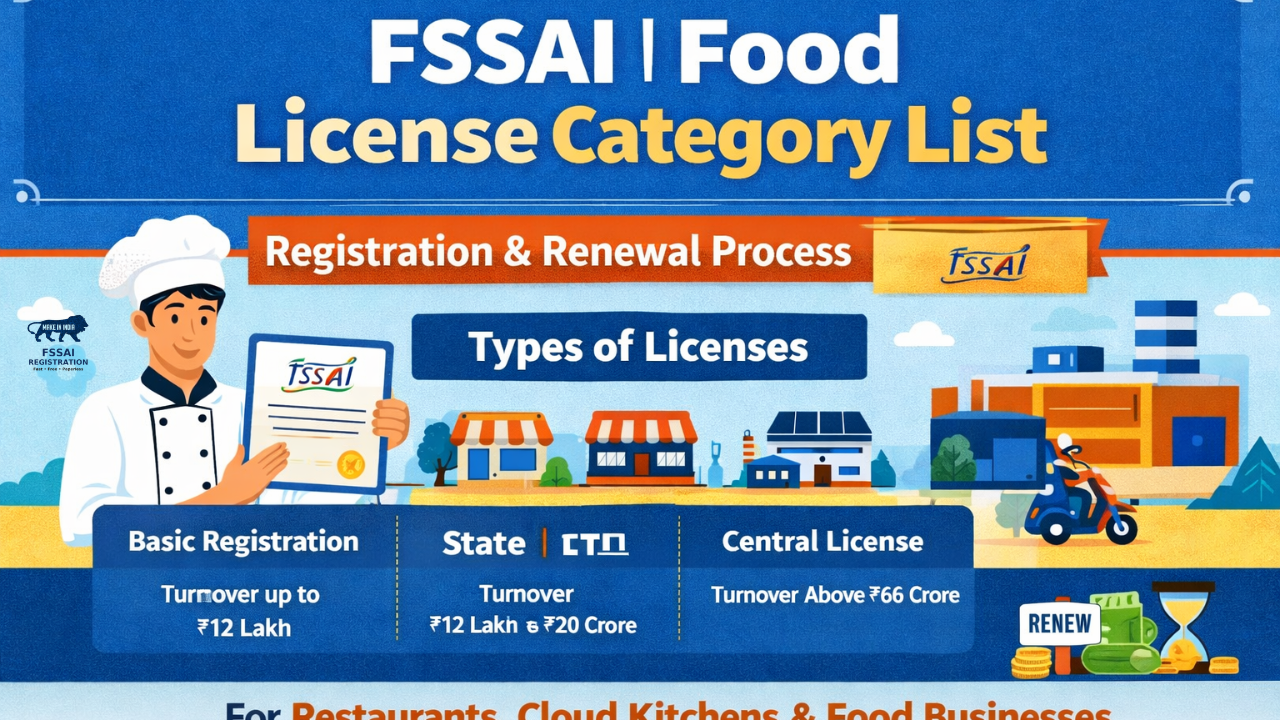
FSSAI Food License Category List | FSSAI Registration Online | FSSAI License Renewal Process
Starting a food-related business in India requires proper legal compliance to ensure food safety and quality. One of the most important requirements is obtaining an FSSAI food license. This license is issued by the Food Safety and Standards Authority of India under the Food Safety and Standards Act, 2006. Whether you run a restaurant, cloud kitchen, food manufacturing unit, or home-based food business, you must obtain an FSSAI license to legally operate.
Understanding the FSSAI food license category list is essential for selecting the correct license based on your business size, annual turnover, and operational scale. In this detailed guide, we will explain the different FSSAI license categories, the registration process, renewal procedures, documents required, fees, and how to apply online through the FOSCOS portal.
What is FSSAI?
FSSAI stands for the Food Safety and Standards Authority of India. It is a government regulatory body responsible for ensuring the safety, quality, and hygiene of food products across the country. Any business involved in manufacturing, processing, storing, distributing, or selling food must obtain an FSSAI registration or license.
The purpose of FSSAI is to:
-
Regulate food safety standards in India
-
Ensure safe and hygienic food for consumers
-
Monitor food manufacturing and distribution processes
-
Issue food safety licenses and certifications
-
Promote awareness about food hygiene and quality
Having an FSSAI license not only ensures compliance with legal regulations but also builds trust among customers.
FSSAI Food License Category List
The FSSAI food license category list is divided into three main categories based on the scale of the business and annual turnover.
1. FSSAI Basic Registration
FSSAI Basic Registration is designed for small-scale food businesses. This registration is suitable for startups, home-based food businesses, petty retailers, and small food vendors.
Eligibility
Businesses with an annual turnover of up to ₹12 lakh must apply for basic FSSAI registration.
Suitable For
-
Home kitchen businesses
-
Street food vendors
-
Small retailers
-
Cottage industries
-
Small food manufacturers
-
Small storage units
Benefits
-
Easy and affordable registration
-
Legal authorization to run a small food business
-
Helps build customer trust
-
Enables listing on online platforms
The registration certificate includes a 14-digit FSSAI registration number, which must be printed on food packages.
2. FSSAI State License
The FSSAI State License is required for medium-sized food businesses operating within a single state.
Eligibility
Businesses with an annual turnover between ₹12 lakh and ₹20 crore must apply for a state license.
Suitable For
-
Restaurants and cafes
-
Medium-scale manufacturers
-
Food processing units
-
Food storage warehouses
-
Transporters and distributors
-
Online food sellers
Features
-
Validity ranges from 1 to 5 years
-
Requires detailed documentation
-
Mandatory inspection in some cases
-
Applicable only within the state
State licenses ensure that medium-scale food businesses follow safety and hygiene standards set by FSSAI.
3. FSSAI Central License
The FSSAI Central License is mandatory for large-scale food businesses operating across multiple states or dealing with import and export activities.
Eligibility
Businesses with annual turnover above ₹20 crore require a central license.
Suitable For
-
Large food manufacturers
-
Importers and exporters of food products
-
Large restaurant chains
-
Food businesses operating in multiple states
-
Large warehouses and storage facilities
-
Businesses supplying to government organizations
Features
-
Regulated directly by the central authority
-
Required for nationwide operations
-
More documentation and compliance checks
This license ensures strict compliance with national food safety regulations.
Importance of FSSAI License
Obtaining an FSSAI license offers several benefits to food businesses.
1. Legal Compliance
Running a food business without FSSAI registration can result in penalties and legal action.
2. Consumer Trust
Customers prefer buying food products that carry an FSSAI certification mark.
3. Business Expansion
Having an FSSAI certificate makes it easier to expand your food business across cities and states.
4. Online Food Platforms
Food delivery platforms such as Zomato and Swiggy require restaurants and cloud kitchens to have an FSSAI license.
5. Government Support
Businesses with FSSAI registration can access government schemes and financial support programs.
FSSAI Registration Process
Applying for FSSAI registration online has become simple with the digital system available through the FOSCOS portal.
Step-by-Step Process
Step 1: Visit the FOSCOS Portal
Go to the official portal and choose the type of registration required.
Step 2: Fill the Application Form
Provide details such as:
-
Business name
-
Business type
-
Address
-
Owner information
-
Food category
Step 3: Upload Required Documents
Applicants must upload the necessary documents for verification.
Step 4: Pay the Application Fee
The fee varies depending on the license category and validity period.
Step 5: Application Review
Authorities verify the submitted information and may conduct inspections.
Step 6: Issuance of Certificate
After successful verification, the FSSAI license or registration certificate is issued.
Documents Required for FSSAI License
The required documents depend on the license type, but generally include:
-
Identity proof of business owner
-
Address proof of business location
-
Passport-size photographs
-
Food safety management plan
-
Business registration certificate
-
List of food products handled
-
Equipment and machinery details
Additional documents may be required for large manufacturing units.
FSSAI License Fees
The FSSAI license fee varies depending on the license type.
Basic Registration Fee
₹100 per year
State License Fee
₹2,000 – ₹5,000 per year depending on business category
Central License Fee
₹7,500 per year
Businesses can choose validity from 1 to 5 years, and fees must be paid accordingly.
FSSAI License for Different Food Businesses
Different types of food businesses require an FSSAI license.
Restaurants
Restaurants must obtain an FSSAI state or central license depending on their turnover.
Home Kitchens
Small home-based food businesses can apply for basic FSSAI registration.
Cloud Kitchens
Cloud kitchens operating through delivery platforms must have FSSAI certification.
Food Manufacturers
Manufacturing units require state or central licenses depending on production scale.
Online Food Sellers
Anyone selling food online must obtain FSSAI registration before listing products.
FSSAI License Renewal
The FSSAI license renewal process must be completed before the license expires.
When to Renew
Businesses should apply for renewal at least 30 days before expiration.
Renewal Process
-
Log in to the FOSCOS portal
-
Select the renewal option
-
Update business details if required
-
Upload updated documents
-
Pay renewal fees
Failure to renew the license on time may result in penalties or cancellation.
Common Mistakes to Avoid
While applying for an FSSAI license, businesses should avoid the following mistakes:
-
Selecting the wrong license category
-
Providing incorrect business details
-
Missing document uploads
-
Delaying license renewal
-
Not displaying the FSSAI number on packaging
Avoiding these mistakes ensures a smooth registration process.
Tips for Easy FSSAI Registration
Here are some helpful tips for obtaining an FSSAI license smoothly:
-
Determine the correct license category before applying
-
Prepare all required documents in advance
-
Ensure accurate business details
-
Choose a longer validity period to avoid frequent renewal
-
Apply online through the official portal for faster processing
FAQs- FSSAI Food License Category List
1. What is the FSSAI food license category list?
It includes Basic Registration, State License, and Central License for different types of food businesses.
Source: Food Safety and Standards Authority of India – https://www.fssai.gov.in
2. Who needs FSSAI registration in India?
Anyone involved in manufacturing, storing, distributing, or selling food must obtain FSSAI registration.
Source: Food Safety and Standards Authority of India – https://www.fssai.gov.in
3. What are the three types of FSSAI licenses?
The three types are Basic Registration, State License, and Central License.
Source: FOSCOS – https://foscos.fssai.gov.in
4. What is the turnover limit for FSSAI Basic Registration?
Basic registration is required for food businesses with turnover up to ₹12 lakh.
Source: Food Safety and Standards Authority of India – https://www.fssai.gov.in
5. Who requires an FSSAI State License?
Food businesses with turnover between ₹12 lakh and ₹20 crore must obtain a State License.
Source: FOSCOS – https://foscos.fssai.gov.in
6. When is an FSSAI Central License required?
A Central License is required for businesses with turnover above ₹20 crore or operating in multiple states.
Source: Food Safety and Standards Authority of India – https://www.fssai.gov.in
7. How can I apply for an FSSAI license online?
You can apply online through the FOSCOS portal by submitting the application form and documents.
Source: FOSCOS – https://foscos.fssai.gov.in
8. What documents are required for FSSAI registration?
Identity proof, address proof, business details, and food product information are generally required.
Source: Food Safety and Standards Authority of India – https://www.fssai.gov.in
9. What is the FSSAI basic registration fee?
The basic registration fee is ₹100 per year for small food businesses.
Source: FOSCOS – https://foscos.fssai.gov.in
10. How long is an FSSAI license valid?
An FSSAI license is valid for 1 to 5 years depending on the selected duration.
Source: Food Safety and Standards Authority of India – https://www.fssai.gov.in
11. When should FSSAI license renewal be done?
FSSAI license renewal should be applied for at least 30 days before the expiry date.
Source: FOSCOS – https://foscos.fssai.gov.in
12. Can a home kitchen get FSSAI registration?
Yes, home kitchens can apply for Basic FSSAI Registration if turnover is within ₹12 lakh.
Source: Food Safety and Standards Authority of India – https://www.fssai.gov.in
13. Is FSSAI license required for cloud kitchens?
Yes, cloud kitchens must obtain an FSSAI license before operating.
Source: Food Safety and Standards Authority of India – https://www.fssai.gov.in
14. Is FSSAI license mandatory for restaurants on food delivery apps?
Yes, restaurants must have an FSSAI license to list on platforms like Swiggy and Zomato.
Source: https://www.fssai.gov.in
15. What happens if a business operates without an FSSAI license?
Operating without an FSSAI license can result in penalties, fines, or closure of the food business.
Source: Food Safety and Standards Authority of India – https://www.fssai.gov.in
Conclusion
Understanding the FSSAI food license category list is crucial for every food business operating in India. Whether you are starting a small home kitchen, running a restaurant, or managing a large food manufacturing company, obtaining the correct FSSAI registration ensures compliance with food safety regulations.
The three main categories—Basic Registration, State License, and Central License—are designed to regulate businesses of different sizes. By applying through the FOSCOS portal, businesses can easily complete the registration process, obtain their FSSAI certificate, and operate legally.
Maintaining compliance through timely FSSAI license renewal, proper documentation, and adherence to food safety guidelines will help businesses grow while ensuring consumer trust and safety.
1. क्या रजिस्ट्रेशन सालाना नवीकरण होता है?
2. क्या बिना GST नंबर के MSME पंजीकरण हो सकता है?
3. 12 अंकों का एमएसएमई पंजीकरण नंबर क्या है?
4. MSME प्रमाणपत्र क्या है?
5. MSME के अंतर्गत कौन-कौन से उद्योग आते हैं?
6. MSME के लिए कौन पात्र है?
- How to register on GeM portal
- GeM पोर्टल हेल्पलाइन नंबर 2026| कस्टमर केयर, ईमेल | टेंडर सहायता
- GeM पोर्टल क्या है | रजिस्ट्रेशन प्रोसेस, फायदे | सरकारी ऑर्डर पाने का तरीका (2026)
- एमएसएमई पंजीकरण 2026 | प्रक्रिया, लाभ, दस्तावेज़ | Udyam Guide
- जेम लॉगिन: GeM Login और रजिस्ट्रेशन की पूरी जानकारी

