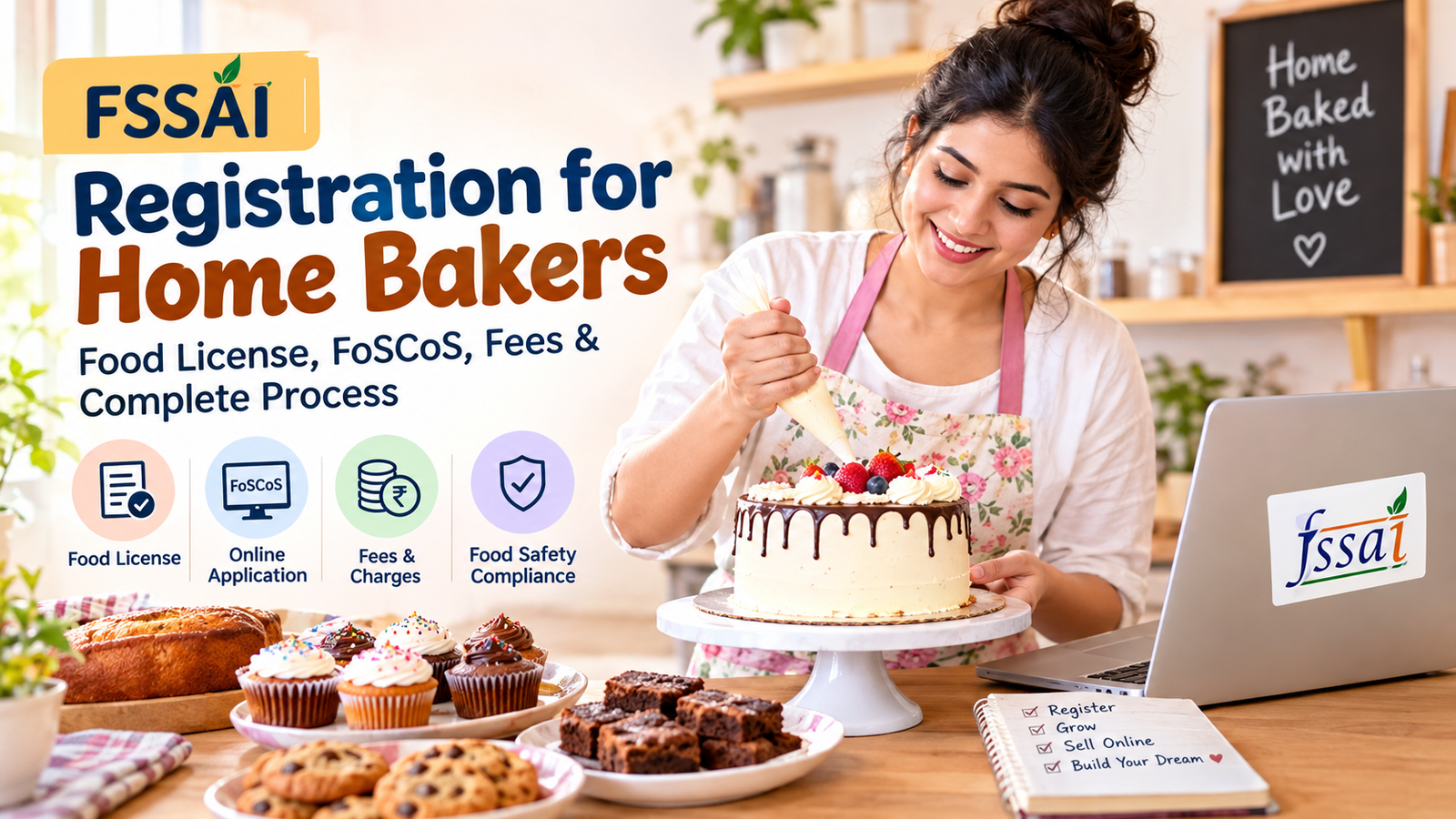
FSSAI Registration for Home Bakers | Fees and Process
Starting a home bakery is a popular way to turn baking skills into a small business. Many people begin by selling cakes, cookies, brownies, breads and other homemade food products through Instagram, WhatsApp, local customers and online platforms.
However, once baking becomes a commercial activity, it is important to understand the food safety and licensing requirements. FSSAI registration for home bakers is one of the key requirements that small food businesses should understand before starting or expanding their operations.
Whether you are baking from your kitchen, taking orders online or supplying cakes and cookies to customers locally, having the appropriate food registration can help you operate your business more systematically.
This guide explains FSSAI license for home bakers, food license for home bakers, FoSCoS registration, eligibility, documents, fees, application process, renewal and other important points.
FSSAI Registration for Home Bakers: Is It Required?
FSSAI registration for home bakers is relevant when a person prepares and sells food products as a business. A home bakery is generally treated as a food business when products such as cakes, cookies, pastries, brownies, breads or other baked foods are prepared for sale.
A person who occasionally bakes for family or friends without conducting a food business is different from someone regularly accepting paid orders.
For example, if you are:
-
Selling homemade cakes
-
Taking cake orders through Instagram
-
Selling cookies from your home kitchen
-
Preparing brownies for customers
-
Supplying baked products locally
-
Running an online home bakery
-
Accepting regular orders through WhatsApp
-
Selling packaged homemade bakery products
you should check which FSSAI registration or licence category applies to your activity.
The requirement depends on factors such as the nature and scale of the food business and the applicable eligibility criteria.
FSSAI License for Home Bakers: Which Registration Is Suitable?
FSSAI license for home bakers can refer to different levels of food registration depending on the size and nature of the business.
For a small home-based bakery, the applicable category may often be Basic FSSAI Registration, provided the business meets the eligibility requirements for that category.
As the business grows, the applicable licence category can change.
A home baker should therefore consider:
-
Nature of bakery products
-
Annual turnover
-
Production scale
-
Business activities
-
Type of customers
-
Whether products are supplied outside the local area
-
Whether the business falls under another applicable food-business category
It is better to determine the appropriate category before submitting the application rather than selecting a category only because the business operates from home.
Food License for Home Bakers: What Does It Cover?
Food license for home bakers is important because baking and selling food commercially comes with food-safety responsibilities.
The registration/licence identifies the food business operator and the relevant food business activity.
Depending on the business, a home baker may deal with products such as:
-
Cakes
-
Cupcakes
-
Brownies
-
Cookies
-
Breads
-
Muffins
-
Pastries
-
Desserts
-
Pies
-
Other baked food products
The exact food category and business activity should be selected carefully during the application.
A home bakery should also maintain proper hygiene, cleanliness, safe storage and appropriate handling practices.
FoSCoS Registration for Home Bakers: How Does the Online Process Work?
FoSCoS registration for home bakers is the online route used for applying for FSSAI registration/licensing.
FoSCoS stands for Food Safety Compliance System. Applicants can use the platform to submit relevant information and documents for their food business.
A general application process includes:
-
Identify the appropriate FSSAI category.
-
Visit the FoSCoS platform.
-
Select the relevant registration/licence option.
-
Enter the applicant and business details.
-
Provide the food business activity.
-
Upload the required documents.
-
Pay the applicable government fee.
-
Submit the application.
-
Track the application status.
-
Receive the registration certificate/licence after approval.
The information submitted should match the actual home bakery business.
FSSAI for Home Bakers: Why Is It Important?
FSSAI for home bakers is not simply about obtaining a certificate. It is also connected with maintaining food-safety standards while operating a food business.
For a home baker, registration can be useful when:
-
Building customer confidence
-
Expanding the bakery
-
Selling through online channels
-
Working with marketplaces
-
Supplying other businesses
-
Maintaining business records
-
Demonstrating food-business compliance
Customers are increasingly interested in knowing where their food comes from and whether a food business follows appropriate safety requirements.
A properly registered food business can therefore present itself more professionally.
FSSAI Home Baker Registration: What Documents Are Required?
FSSAI home baker registration generally requires basic information about the applicant and the food business.
The exact documents can vary depending on the registration/licence category and business circumstances.
Commonly required information may include:
-
Applicant's identity details
-
Photograph
-
Address proof
-
Business address
-
Details of the food business
-
Nature of food products
-
Food business activity
-
Contact details
-
Relevant supporting documents, wherever applicable
For a simple home-based food business, documentation may be relatively straightforward compared with larger food manufacturing operations.
However, applicants should provide accurate information and use documents that support the details entered in the application.
FSSAI Home Bakers: Can You Run a Bakery From Your Home?
FSSAI home bakers can operate a home-based food business provided they meet the applicable food-safety, registration/licensing and other local requirements.
Operating from a residential kitchen does not automatically mean that food-business regulations do not apply.
If you regularly prepare food for commercial sale, you should consider the relevant requirements before starting operations.
Apart from FSSAI requirements, depending on your location and business model, you may also need to consider:
-
Local municipal rules
-
Shop and establishment requirements
-
Packaging requirements
-
Labelling requirements
-
GST applicability
-
Delivery and marketplace requirements
-
Fire or other local requirements where applicable
These requirements can vary according to the location and scale of the business.
FSSAI Registration Fees for Home Bakers: How Much Does It Cost?
FSSAI registration fees for home bakers depend on the applicable registration or licence category.
For eligible businesses under Basic Registration, the official government fee is generally ₹100 per year.
Other categories can have higher government fees depending on the type of licence and food business.
The fee structure can therefore differ based on the category selected.
Basic Registration
For eligible small food businesses:
Government fee: ₹100 per year
For example:
-
1 year = ₹100
-
2 years = ₹200
-
3 years = ₹300
-
4 years = ₹400
-
5 years = ₹500
The actual amount payable can also depend on the application category and any applicable service or professional assistance charges.
FSSAI Registration for Home Bakers Fees: Government Fee vs Service Charges
FSSAI registration for home bakers fees should be understood separately from professional assistance charges.
The government fee is the official fee applicable to the selected registration/licence category.
If a private consultant or service provider helps with the application, additional charges may apply for services such as:
-
Form filling
-
Document assistance
-
Application submission
-
Application tracking
-
Correction assistance
-
Certificate-related support
These professional charges are not the same as the government FSSAI fee.
Therefore, before paying an amount to any private service provider, ask for a clear breakdown of government fees and service charges.
Home Bakers FSSAI Registration: How to Apply Online?
Home bakers FSSAI registration can be initiated online through the FoSCoS system.
The basic process can be understood in the following steps.
Step 1: Determine Your Business Category
First, identify whether your home bakery falls under Basic Registration or another applicable category.
Step 2: Prepare Your Documents
Keep your identity, address and business-related information ready.
Step 3: Complete the Application
Enter the applicant details, business address and food-business information carefully.
Step 4: Select Food Products
Mention the products you actually manufacture, prepare, store or sell.
Step 5: Upload Documents
Upload the required documents in the prescribed format.
Step 6: Pay the Applicable Fee
Pay the government fee applicable to your selected category.
Step 7: Submit the Application
Review the details before submitting the application.
Step 8: Track the Application
Keep the application/reference number safe so that you can check the status when required.
Starting a Bakery From Home: What Should You Plan First?
Starting a bakery from home involves more than buying an oven and accepting orders. A proper plan can make the business easier to manage as it grows.
Before starting, consider:
-
What products will you sell?
-
Who are your customers?
-
What will be your pricing?
-
How will you accept orders?
-
What packaging will you use?
-
How will you manage deliveries?
-
What food registration is applicable?
-
How will you maintain hygiene?
-
Will you sell locally or online?
A small menu is often easier to manage in the beginning.
For example, a new home bakery could start with:
-
Birthday cakes
-
Cupcakes
-
Brownies
-
Cookies
-
Tea cakes
The product range can later be expanded according to customer demand.
Running a Bakery From Home: Food Safety Practices
Running a bakery from home requires attention to cleanliness and safe food handling.
Some useful practices include:
-
Keep the kitchen clean.
-
Wash hands before food preparation.
-
Use clean utensils and equipment.
-
Store ingredients properly.
-
Check ingredient expiry dates.
-
Prevent cross-contamination.
-
Keep raw and ready-to-eat ingredients appropriately separated.
-
Maintain suitable storage conditions.
-
Clean work surfaces regularly.
-
Use food-grade packaging where applicable.
For home bakers, maintaining consistent hygiene is especially important because the same kitchen may also be used for household activities.
Starting My Own Bakery From Home: How Can I Build Customers?
Starting my own bakery from home can begin with a simple local marketing strategy.
You can promote your products through:
-
Instagram
-
WhatsApp Business
-
Facebook
-
Google Business Profile
-
Local communities
-
Word-of-mouth referrals
-
Your own home bakery website
Good-quality product photographs can help customers understand what you offer.
You can also create a simple menu containing:
-
Product name
-
Size
-
Price
-
Flavour options
-
Egg/eggless option
-
Advance-order requirement
-
Delivery area
-
Contact method
Home Bakery Website: Is a Website Useful for Home Bakers?
Home bakery website can help a growing bakery create a professional online presence.
A website can include:
-
Home page
-
About the bakery
-
Cake menu
-
Product catalogue
-
Pricing information
-
Order instructions
-
Contact details
-
Delivery information
-
FSSAI registration/licence details where appropriate
-
Customer reviews
A home based bakery website can also help customers discover your products through search engines.
However, a website is not a replacement for required food registration or other legal compliance.
Home Bakery Online: Can Home Bakers Take Orders Online?
Home bakery online businesses can receive orders through websites, social media and messaging applications.
A home baker can offer:
-
Custom birthday cakes
-
Anniversary cakes
-
Cupcake boxes
-
Brownie boxes
-
Cookies
-
Festival products
-
Dessert boxes
Before accepting online orders, clearly communicate:
-
Product details
-
Price
-
Order deadline
-
Delivery charges
-
Delivery area
-
Cancellation policy
-
Storage instructions
This helps reduce misunderstandings between the baker and customer.
Cake Pricing for Home Bakery: How Should You Decide Prices?
Cake pricing for home bakery products should cover both direct and indirect costs.
Consider:
-
Flour
-
Sugar
-
Butter
-
Cream
-
Chocolate
-
Eggs
-
Flavouring
-
Decorations
-
Cake boards
-
Boxes
-
Electricity
-
Delivery
-
Labour/time
-
Wastage
-
Marketing expenses
For example, if a cake costs ₹500 to produce, simply adding a small percentage may not cover your actual business expenses.
Home bakers should calculate the complete cost before deciding their selling price.
Home Bakery Cake Prices: What Factors Affect the Price?
Home bakery cake prices can vary significantly depending on the design and ingredients.
A simple cake may cost less than a highly customised cake.
Pricing can depend on:
-
Cake size
-
Flavour
-
Ingredients
-
Cream type
-
Decoration
-
Fondant work
-
Custom design
-
Number of servings
-
Delivery distance
-
Urgent order requirements
Therefore, it is better to create a structured price list rather than quoting random prices for every order.
Best Home Bakers: What Should Customers Check?
People searching for best home bakers or best home bakers near me should look beyond photographs.
Before placing an order, customers can check:
-
Customer reviews
-
Product photographs
-
Menu
-
Pricing
-
Delivery policy
-
Hygiene practices
-
FSSAI details where applicable
-
Customer feedback
-
Business contact information
For customised cakes, customers should also confirm the design, size, flavour and delivery time before making payment.
Home Bakers Near Me: How Can Customers Find Local Home Bakeries?
Searches such as home bakers near me, home bakery near me and home based bakery near me are commonly used by customers looking for nearby cake and bakery services.
A home bakery can improve local visibility by maintaining:
-
A Google Business Profile where eligible
-
Updated contact details
-
Accurate service area
-
Product photographs
-
Customer reviews
-
Social media profiles
-
A simple website
Local visibility can help customers discover a bakery without relying only on paid advertising.
Home Cake Bakers Near Me: What Products Can They Offer?
People searching for home cake bakers near me may be looking for customised cakes for birthdays, weddings, anniversaries or other occasions.
Popular home-bakery products include:
-
Chocolate cake
-
Red velvet cake
-
Vanilla cake
-
Fruit cake
-
Cupcakes
-
Brownies
-
Cookies
-
Cheesecakes
-
Tea cakes
-
Custom theme cakes
Home bakers should clearly mention whether products are eggless, contain nuts or have other relevant allergen considerations.
Bakery Cake at Home: Can You Sell Homemade Cakes Commercially?
Bakery cake at home can be prepared for commercial sale, but the business should follow applicable food-safety and registration requirements.
A home bakery should not assume that operating from a residential property automatically exempts it from food-business requirements.
Before starting regular commercial sales, check:
-
Applicable FSSAI category
-
Local business requirements
-
Food safety practices
-
Packaging and labelling requirements
-
Tax requirements, if applicable
-
Delivery and marketplace requirements
FAQs About FSSAI Registration for Home Bakers
1. Is FSSAI registration required for home bakers?
Yes, commercial home bakers need the applicable FSSAI registration or licence.
Source: FSSAI Registration
2. Which FSSAI registration is suitable for a small home bakery?
Eligible small home bakeries may apply for FSSAI Registration, depending on their business category.
Source: FSSAI Eligibility
3. What is the FSSAI registration fee for a home baker?
The government fee for applicable Basic Registration is generally ₹100 per year.
Source: FSSAI Fee Structure
4. Can I apply for FSSAI registration online?
Yes, you can apply online through the FoSCoS portal.
Source: FoSCoS Portal
5. Can I get FSSAI registration for a home kitchen?
Yes, a home-based food business can obtain the applicable FSSAI registration/licence.
Source: FSSAI Registration
6. Do home bakers need a food licence?
Yes, commercial home bakers should obtain the applicable FSSAI registration or licence.
Source: FSSAI Licensing
7. Can I sell cakes through Instagram?
Yes, but applicable FSSAI and food-safety requirements still apply.
Source: FSSAI Registration
8. Can I sell homemade cookies online?
Yes, provided applicable food-safety and registration requirements are followed.
Source: FSSAI Food Business
9. Is FoSCoS registration the same as FSSAI registration?
FoSCoS is the online system used for FSSAI registration and licensing services.
Source: FoSCoS
10. Can a home baker sell products without a physical bakery shop?
Yes, a bakery can operate from home if it meets applicable FSSAI and local requirements.
Source: FSSAI Registration
11. How long is FSSAI registration valid?
Under the 2026 reforms, FSSAI registration and licences have perpetual validity, subject to applicable conditions.
Source: FSSAI 2026 Reforms
12. Can I renew my FSSAI registration?
The 2026 reforms introduced perpetual validity, changing the earlier fixed renewal system.
Source: FSSAI 2026 Reforms
13. Can I sell cakes through WhatsApp?
Yes, but applicable FSSAI requirements still apply to the food business.
Source: FSSAI Registration
14. Does a home baker need to display the FSSAI number?
Where applicable, the FSSAI number must be displayed or declared according to the relevant requirements.
Source: FSSAI Compliance
15. Can a home baker expand into a commercial bakery later?
Yes. As the business grows, its FSSAI category and other compliance requirements should be reviewed.
Source: FSSAI Eligibility
Conclusion
FSSAI registration for home bakers is an important part of setting up a compliant home-based bakery. Whether you are selling cakes, cookies, brownies, breads or other baked products, understanding the appropriate FSSAI category can help you start your business with greater clarity.
For small businesses, FSSAI registration for home bakers fees can be relatively low when the business qualifies for Basic Registration, with the applicable government fee generally starting at ₹100 per year.
Before applying, carefully check your business activity, eligibility, documents and applicable food category. If you are planning starting a bakery from home, it is also useful to plan your pricing, packaging, online presence, hygiene practices and customer-order process from the beginning.
1. क्या रजिस्ट्रेशन सालाना नवीकरण होता है?
2. क्या बिना GST नंबर के MSME पंजीकरण हो सकता है?
3. 12 अंकों का एमएसएमई पंजीकरण नंबर क्या है?
4. MSME प्रमाणपत्र क्या है?
5. MSME के अंतर्गत कौन-कौन से उद्योग आते हैं?
6. MSME के लिए कौन पात्र है?
- How to register on GeM portal
- GeM पोर्टल हेल्पलाइन नंबर 2026| कस्टमर केयर, ईमेल | टेंडर सहायता
- GeM पोर्टल क्या है | रजिस्ट्रेशन प्रोसेस, फायदे | सरकारी ऑर्डर पाने का तरीका (2026)
- एमएसएमई पंजीकरण 2026 | प्रक्रिया, लाभ, दस्तावेज़ | Udyam Guide
- जेम लॉगिन: GeM Login और रजिस्ट्रेशन की पूरी जानकारी

