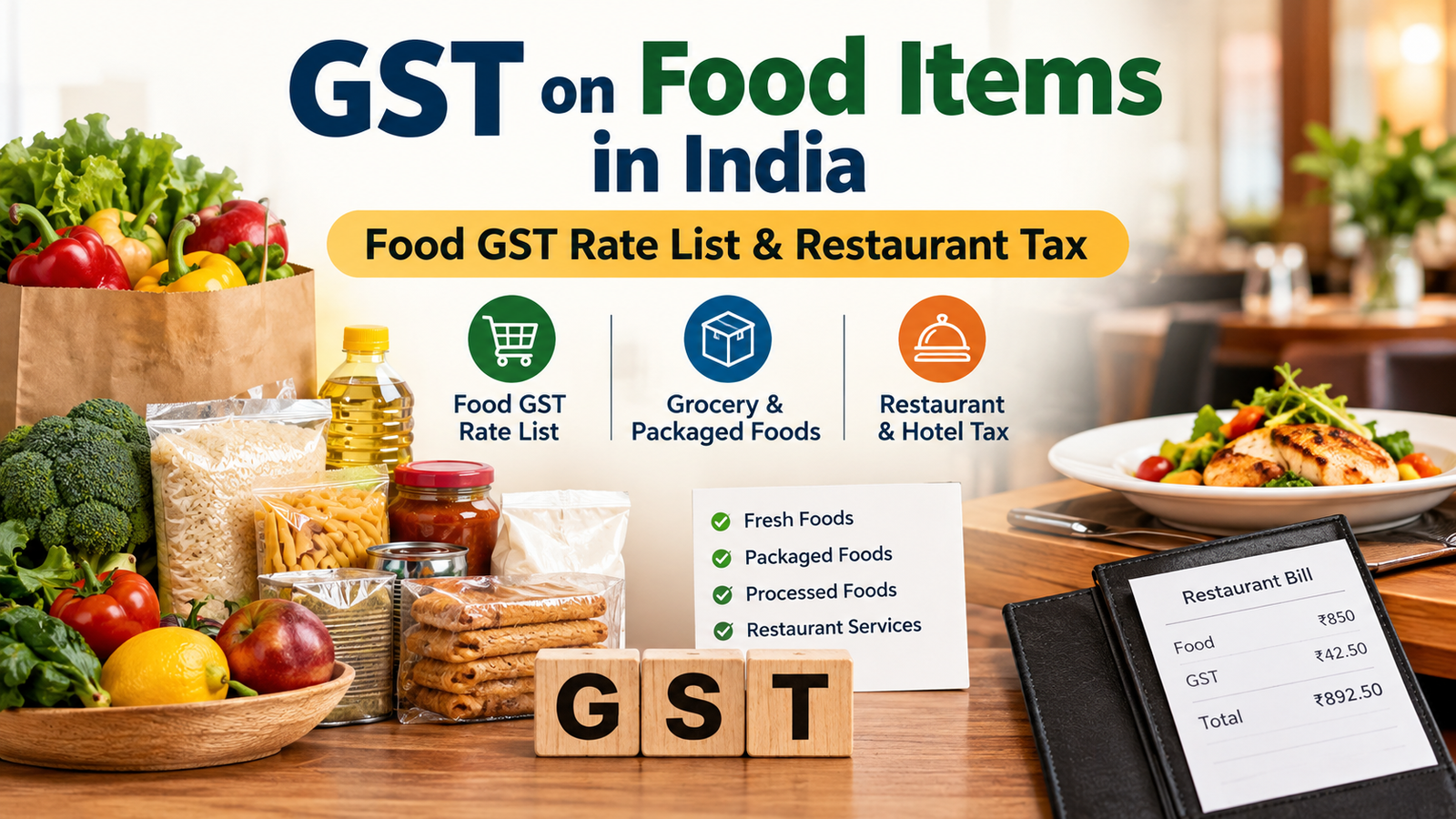
GST on Food Items in India | Food GST Rate List | Restaurant Tax
GST on food items is an important topic for consumers, grocery shop owners, food manufacturers, restaurant owners, and food businesses in India. The Goods and Services Tax (GST) is charged on certain food products, packaged groceries, processed foods, and restaurant services, while many essential food items are exempt from GST.
The GST on food items in India depends on the type of food, how it is processed, whether it is pre-packaged and labelled, and the category under which it is classified. For example, fresh vegetables and many unprocessed food grains are generally exempt, while certain packaged food products attract GST at applicable rates.
Understanding the food GST rate is useful for checking grocery bills, calculating the GST on food bills in restaurants, and managing tax compliance for food businesses. Businesses involved in selling, manufacturing, or serving food may also need food registration or an FSSAI licence, depending on the nature and scale of their operations.
In this guide, we will explain the GST rate on food items, grocery items GST rate, hotel food GST rate, GST on rice, flour, fruits, vegetables, snacks, and other common food products.
Important: GST rates can change through government notifications. The rates discussed below are based on the CBIC GST rate schedule and should be checked against the latest applicable notification before billing or filing returns.
What Is GST on Food Items?
GST on food items refers to the Goods and Services Tax applicable to food products sold or supplied in India. It may apply to raw agricultural products, packaged groceries, processed foods, beverages, and prepared meals, depending on the applicable GST classification.
The GST system generally places food products into different categories:
-
Nil-rated or exempt food items: Many fresh vegetables, fresh fruits, and certain unprocessed staples.
-
5% GST food items: Certain pre-packaged and labelled food grains, flour, and other eligible food products.
-
12% GST food items: Some processed foods, preserved products, and other specified items.
-
18% GST food items: Certain packaged and processed food products, depending on their classification.
The exact food GST percentage is not the same for every item. A product's packaging, processing, composition, and HSN classification can affect the applicable rate.
Food GST Rate List: GST on Food Items in India
The following table provides a general overview of common food products and their usual GST treatment. The final rate depends on the precise product description and applicable conditions.
|
Food Item |
General GST Treatment |
|---|---|
|
Fresh vegetables |
Nil |
|
Fresh fruits |
Generally nil |
|
Fresh milk |
Nil |
|
Rice sold loose |
Nil |
|
Wheat sold loose |
Nil |
|
Loose wheat flour |
Nil |
|
Pre-packaged and labelled rice |
5% |
|
Pre-packaged and labelled wheat flour |
5% |
|
Pre-packaged and labelled pulses |
5% in applicable categories |
|
Packaged puffed rice |
5% in applicable categories |
|
Bread |
Generally nil |
|
Biscuits |
Often 18%, depending on classification |
|
Pasta and noodles |
Generally 12% |
|
Certain preserved vegetables |
Generally 12% |
|
Restaurant services |
Generally 5% without ITC, subject to exceptions |
These are broad examples, not a substitute for checking the exact HSN code and current GST notification.
GST on Rice: Loose Rice, Packaged Rice, and Rice Above 25 kg
GST on rice depends on the packaging and labelling conditions applicable to the product.
GST on loose rice
Rice sold loose and not covered by the pre-packaged and labelled category is generally exempt from GST.
GST on packaged rice
Rice sold in qualifying pre-packaged and labelled form generally attracts 5% GST under the relevant rate entry.
GST on rice above 25 kg
The GST on rice above 25 kg is a common question among wholesalers and bulk buyers. The weight alone does not determine the rate. The relevant conditions include the nature of the package and whether the product is treated as pre-packaged and labelled under GST rules.
A bulk supply should therefore not automatically be assumed to be exempt or taxable merely because the bag weighs more than 25 kg.
Unbranded rice GST rate
The term "unbranded rice" does not by itself establish the GST rate. The packaging and labelling conditions and the applicable tariff classification must be considered.
GST on Wheat, Flour, and Other Grocery Items
GST on grocery items depends on the specific product and how it is supplied. Essential food staples are treated differently from certain packaged and processed products.
GST on flour
Loose wheat flour that falls under the applicable exempt category is generally nil-rated. Pre-packaged and labelled wheat flour generally attracts 5% GST under the relevant entry.
GST on wheat and grains
Loose wheat and certain other unprocessed grains are generally exempt. Pre-packaged and labelled products such as rice, maize, oats, and specified cereals may attract 5% GST under the applicable conditions.
GST on pulses and dals
Pulses sold loose and qualifying unprocessed products may be exempt. Certain pre-packaged and labelled products are taxable at 5%, subject to the relevant classification.
GST on sugar and jaggery
The GST rate on sugar and jaggery depends on the product category and packaging conditions. Certain forms of jaggery and khandsari sugar supplied without pre-packaging and labelling are exempt under the applicable entry.
GST on Fruits and Vegetables
GST on fruits and vegetables is an important consideration for grocery shops, fruit sellers, vegetable vendors, and food distributors.
GST on fresh fruits
Fresh fruits are generally exempt from GST. However, dried, preserved, processed, or otherwise prepared fruit products may attract GST.
|
Fruit Category |
General GST Treatment |
|---|---|
|
Fresh mangoes |
Nil |
|
Fresh apples |
Generally nil |
|
Fresh bananas |
Generally nil |
|
Fresh oranges |
Generally nil |
|
Dried fruits |
Depends on product; often taxable |
|
Fruit juice |
Generally taxable |
|
Preserved fruits |
Depends on processing and classification |
GST on vegetables
Fresh or chilled vegetables are generally exempt from GST. The same treatment may apply to certain frozen, dried, or provisionally preserved vegetables under specified conditions. Processed vegetable products can attract GST.
|
Vegetable Category |
General GST Treatment |
|---|---|
|
Fresh potatoes |
Nil |
|
Fresh tomatoes |
Nil |
|
Fresh onions |
Nil |
|
Fresh cabbage |
Nil |
|
Fresh carrots |
Nil |
|
Fresh cauliflower |
Nil |
|
Certain preserved vegetables |
Generally 12% |
|
Certain prepared vegetable products |
Depends on classification |
The GST rate for vegetables depends on whether the product is fresh, frozen, dried, preserved, or processed.
Vegetables HSN Code and GST Rate
Vegetables are generally classified under Chapter 07 of the HSN system.
|
Vegetable Category |
HSN Heading |
General GST Treatment |
|---|---|---|
|
Potatoes |
0701 |
Nil |
|
Tomatoes |
0702 |
Nil |
|
Onions and garlic |
0703 |
Nil |
|
Cabbage and cauliflower |
0704 |
Nil |
|
Carrots and similar roots |
0706 |
Nil |
|
Cucumbers |
0707 |
Nil |
|
Leguminous vegetables |
0708 |
Nil |
|
Other fresh vegetables |
0709 |
Nil |
These headings cover the specified fresh or chilled products. Processed vegetables may fall under other HSN headings and attract different rates.
GST on Dairy Products
GST on dairy products varies according to the type of product, its processing, and its packaging.
|
Dairy Product |
General GST Treatment |
|---|---|
|
Fresh milk |
Nil |
|
UHT milk |
5% under the applicable entry |
|
Curd |
Depends on packaging and product classification |
|
Paneer |
Depends on packaging and applicable classification |
|
Butter |
Generally taxable |
|
Cheese |
Generally taxable |
|
Ghee |
Generally taxable |
Fresh milk is generally exempt, while UHT milk is listed at 5% in the CBIC rate schedule. Other dairy products must be checked against their applicable HSN classification and conditions.
GST on Snacks, Biscuits, and Packaged Food Products
GST on snacks and packaged food products depends on their ingredients, preparation, and classification.
GST rate on snacks
Different snack products can attract different rates. For example, certain ready-to-eat namkeens and similar edible preparations are covered by a 5% entry, while other snack products may attract different rates.
GST on biscuits
Biscuits and many bakery products are generally covered by the 18% GST category under the relevant tariff entry, subject to product-specific exceptions.
GST on puffed rice
Puffed rice, commonly known as muri, is generally exempt when it is not pre-packaged and labelled. Qualifying pre-packaged and labelled puffed rice generally attracts 5% GST.
GST on common packaged foods
|
Food Product |
General GST Treatment |
|---|---|
|
Bread |
Nil in applicable categories |
|
Plain chapatti or roti |
5% under the applicable entry |
|
Khakhra |
5% under the applicable entry |
|
Rusks |
5% under the applicable entry |
|
Biscuits |
Generally 18% |
|
Pasta |
Generally 12% |
|
Certain ready-to-eat namkeens |
5% under the applicable entry |
|
Corn flakes |
Generally 18% |
The rate depends on the exact product and its classification.
GST on Food in Hotels and Restaurants
GST on food in hotels and restaurants is different from the GST on packaged food products sold in grocery stores.
When a restaurant prepares and serves food, the transaction is generally treated as a restaurant service rather than simply a sale of individual food items.
GST for food in restaurants
Restaurant services other than those supplied at specified premises are generally subject to 5% GST without input tax credit (ITC).
This means that eligible restaurant services generally attract a total GST rate of 5%, subject to applicable conditions and exceptions.
Hotel food GST rate
The hotel food GST rate depends on the nature of the service and whether the premises fall under the specified-premises category.
|
Type of Service |
General GST Rate |
|---|---|
|
Restaurant service outside specified premises |
5% without ITC |
|
Restaurant service at specified premises |
Generally 18% |
|
Outdoor catering |
Depends on the applicable category |
|
Food supplied by eligible railway catering services |
5% without ITC |
The classification of the premises and the nature of the service determine the applicable rate.
GST on food in hotels with accommodation
Hotel accommodation and restaurant services are separate categories for GST purposes.
The accommodation tariff and the classification of the premises can affect the applicable GST treatment. Therefore, the GST on a hotel food bill should not automatically be calculated using the accommodation tax rate.
GST on Food Bill in Restaurants: How to Calculate
The GST on a food bill depends on the applicable restaurant service rate and the taxable value of the bill.
For an eligible restaurant service subject to 5% GST, the calculation is:
GST Amount = Taxable Bill Amount × 5%
Example of a restaurant food bill
Suppose a restaurant bill contains food worth ₹1,000 before GST.
|
Particulars |
Amount |
|---|---|
|
Food bill before GST |
₹1,000 |
|
CGST at 2.5% |
₹25 |
|
SGST at 2.5% |
₹25 |
|
Total GST |
₹50 |
|
Final bill amount |
₹1,050 |
This example assumes that the restaurant service is eligible for the 5% rate and that no other charges or special tax treatment apply.
Food bill GST rate: Important points
-
The GST rate depends on the category of restaurant service.
-
Eligible restaurant services generally attract 5% GST without ITC.
-
Specified-premises services may attract a different rate.
-
The bill should show the applicable GST details as required by the rules.
GST on Food and Beverages: Packaged Drinks and Other Products
GST on food and beverages varies according to the product's composition and classification.
|
Product Category |
General GST Treatment |
|---|---|
|
Fresh milk |
Nil |
|
Packaged tender coconut water |
12% under the applicable entry |
|
Certain fruit juices |
Generally 12% |
|
Coffee preparations |
Depends on product classification |
|
Packaged drinking water |
Depends on classification |
|
Aerated beverages |
May attract higher GST and applicable cess |
Not every beverage has the same food GST rate. Check the applicable HSN code and current rate notification before determining the final tax.
GST on Dry Fish and Dog Food
Some food products require special attention because their classification differs from ordinary grocery items.
GST on dry fish
GST on dry fish depends on whether the fish is fresh, chilled, dried, salted, smoked, or otherwise prepared.
Certain specified pre-packaged and labelled fish products attract 5% GST, while other products may fall under different categories.
Dog food GST rate
Dog food is not classified in the same way as ordinary human food. It is generally treated as animal feed or a prepared animal food product.
The GST rate depends on the applicable HSN classification and product description. Businesses should verify the rate for the specific dog food product rather than applying the standard food GST rate.
GST on Food Processing Industry
GST on the food processing industry depends on the type of goods manufactured, the processing activity, and the applicable classification.
Food processing businesses may deal with several different GST categories, including:
-
Raw agricultural products.
-
Packaged food grains and flour.
-
Preserved fruits and vegetables.
-
Ready-to-eat food products.
-
Bakery products and snacks.
-
Food processing machinery and equipment.
The GST rate on a finished food product may differ from the rate on the raw materials used to manufacture it.
Businesses should also consider input tax credit eligibility, invoicing requirements, and applicable registration rules.
GST on dairy machinery
Dairy machinery is classified according to the equipment's function and applicable HSN heading. Its GST rate is not necessarily the same as the rate on milk or other dairy products.
GST-Free Food List in India
Many essential food products are exempt from GST when supplied under the applicable conditions.
Common examples include:
-
Fresh or chilled vegetables.
-
Fresh fruits covered by exempt entries.
-
Fresh milk.
-
Rice supplied outside the taxable pre-packaged and labelled category.
-
Wheat supplied outside the applicable taxable category.
-
Certain loose flour products.
-
Certain unprocessed cereals and pulses.
-
Bread covered by the exempt entry.
-
Certain forms of jaggery supplied without pre-packaging and labelling.
The exemption depends on the precise product description and applicable GST conditions.
GST for Food Business Owners
GST for food businesses depends on the nature of the business, its turnover, the type of supply, and the applicable registration and tax rules.
Food businesses may include:
-
Grocery shops and supermarkets.
-
Restaurants and cafés.
-
Food manufacturing units.
-
Packaged food brands.
-
Food wholesalers and distributors.
-
Catering businesses.
-
Online food sellers.
Important GST compliance points
1. Identify the correct HSN or SAC code: Goods generally use HSN classification, while services such as restaurant services use SAC classification.
2. Apply the correct GST rate: The tax rate should be determined based on the exact product or service.
3. Maintain proper invoices: Taxable supplies must be invoiced in accordance with applicable GST rules.
4. Check registration requirements: GST registration depends on the applicable turnover thresholds, nature of supplies, and other legal conditions.
5. Review input tax credit eligibility: Some categories, including restaurant services taxed at 5%, have restrictions on input tax credit.
How to Check the Latest GST Rates on Food Items
To verify the latest GST rate on a particular food product:
-
Identify the exact product name and composition.
-
Determine the relevant HSN or SAC classification.
-
Check whether the item is fresh, processed, packaged, or labelled.
-
Refer to the applicable GST rate schedule.
-
Review any relevant government notification or clarification.
Frequently Asked Questions (FAQs)
1. What is the GST on food items in India?
GST on food items varies according to the product. Many essential food items are exempt, while other products may attract 5%, 12%, 18%, or another applicable rate.
Government link: CBIC GST Rates – Goods
2. What is the food GST rate?
The food GST rate depends on the type of food, packaging, processing, and classification. There is no single GST rate for all food products.
Government link: CBIC GST Rate Schedule
3. What is the GST on rice?
Loose rice is generally exempt. Qualifying pre-packaged and labelled rice generally attracts 5% GST.
Government link: CBIC GST Rates – Goods
4. What is the GST on rice above 25 kg?
The weight alone does not determine the GST rate. The packaging, labelling, and applicable classification must be checked.
Government link: CBIC GST Rate Schedule
5. What is the GST on flour?
Loose wheat flour is generally exempt, while qualifying pre-packaged and labelled wheat flour generally attracts 5% GST.
Government link: CBIC GST Rates – Goods
6. What is the GST on fresh vegetables?
Fresh or chilled vegetables covered by the applicable exempt entries are generally nil-rated.
Government link: CBIC GST Rate Schedule
7. What is the GST on fruits and vegetables?
Fresh fruits and vegetables are generally exempt, while certain dried, preserved, or processed products may attract GST.
Government link: CBIC GST Rates – Goods
8. What is the GST rate on food in restaurants?
Eligible restaurant services other than those at specified premises generally attract 5% GST without input tax credit.
Government link: CBIC GST Rates – Services
9. What is the hotel food GST rate?
The rate depends on the type of restaurant service and whether the premises qualify as specified premises. The applicable rate may be 5% or 18%.
Government link: CBIC GST Rate Schedule
10. Is GST charged on a restaurant food bill?
Yes, eligible taxable restaurant services generally attract GST. The rate depends on the category of service.
Government link: CBIC GST Rates – Services
11. What is the GST on biscuits?
Biscuits are generally covered by the 18% GST category, subject to the exact product classification and applicable exceptions.
Government link: CBIC GST Rates – Goods
12. What is the GST on puffed rice?
Puffed rice supplied outside the pre-packaged and labelled category is generally exempt. Qualifying pre-packaged and labelled puffed rice generally attracts 5% GST.
Government link: CBIC GST Rate Schedule
13. What is the GST on dry fish?
The rate depends on the type of fish product, its preparation, packaging, and applicable classification.
Government link: CBIC GST Rates – Goods
14. What is the GST on dog food?
Dog food is classified separately from ordinary human food. The applicable rate depends on its HSN classification and product details.
Government link: CBIC GST Rate Schedule
15. Are all grocery items exempt from GST?
No. Many essential grocery items are exempt, but certain packaged, processed, and prepared food products attract GST.
Government link: CBIC GST Rates – Goods
Conclusion
GST on food items in India depends on the nature of the product, its processing, packaging, labelling, and classification. Fresh vegetables, many fresh fruits, and several essential food staples are generally exempt, while certain packaged food products and restaurant services attract GST.
For consumers, understanding food GST rates helps in checking grocery bills and restaurant bills. For food businesses, correct classification and tax-rate verification are important for billing and compliance.
Before applying a GST rate to any food product, always verify its exact HSN or SAC classification and the latest applicable GST notification.
1. क्या रजिस्ट्रेशन सालाना नवीकरण होता है?
2. क्या बिना GST नंबर के MSME पंजीकरण हो सकता है?
3. 12 अंकों का एमएसएमई पंजीकरण नंबर क्या है?
4. MSME प्रमाणपत्र क्या है?
5. MSME के अंतर्गत कौन-कौन से उद्योग आते हैं?
6. MSME के लिए कौन पात्र है?
- How to register on GeM portal
- GeM पोर्टल हेल्पलाइन नंबर 2026| कस्टमर केयर, ईमेल | टेंडर सहायता
- GeM पोर्टल क्या है | रजिस्ट्रेशन प्रोसेस, फायदे | सरकारी ऑर्डर पाने का तरीका (2026)
- एमएसएमई पंजीकरण 2026 | प्रक्रिया, लाभ, दस्तावेज़ | Udyam Guide
- जेम लॉगिन: GeM Login और रजिस्ट्रेशन की पूरी जानकारी

