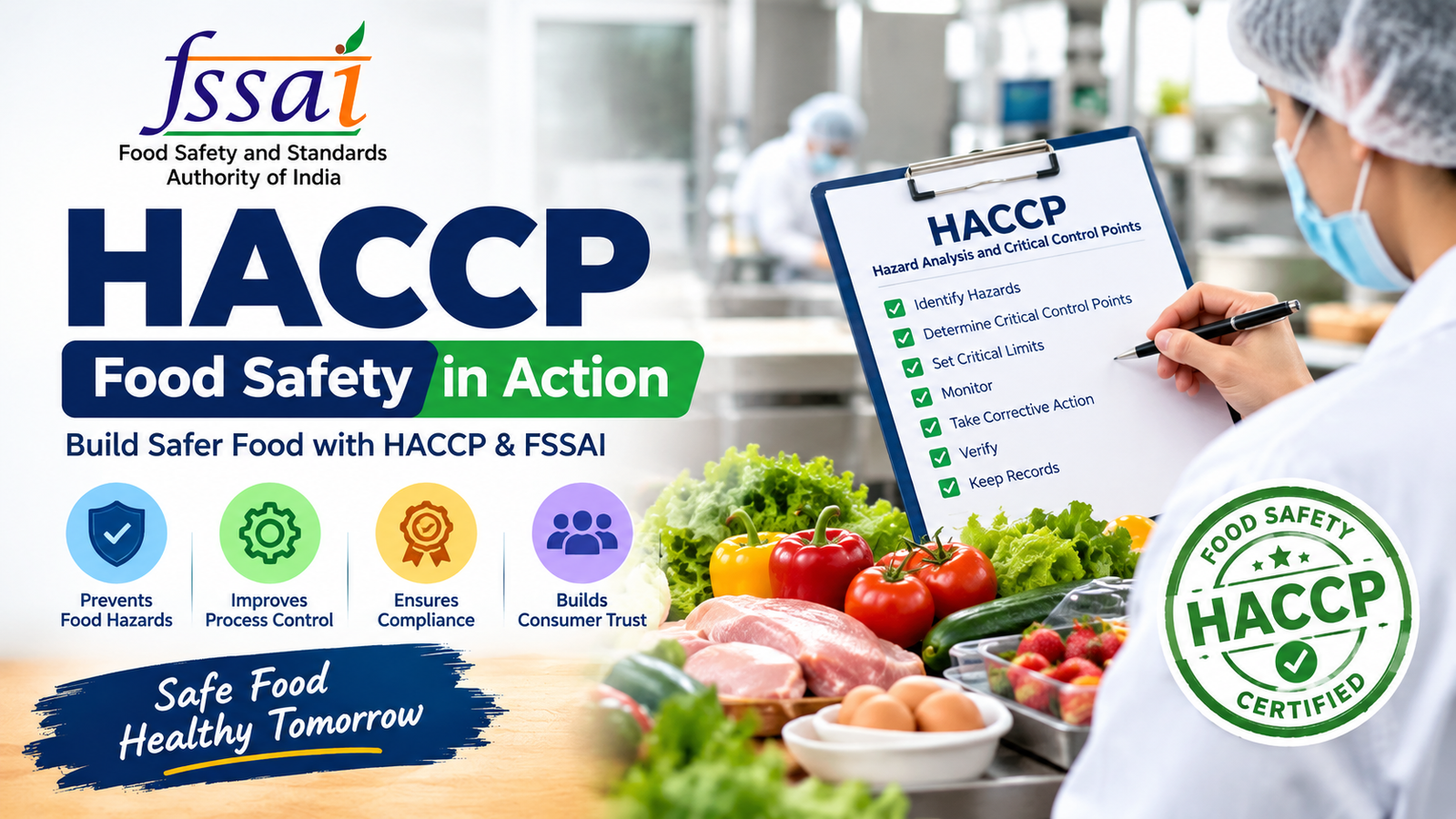
HACCP FSSAI: Complete Food Safety Management System Guide for Food Businesses
HACCP FSSAI is one of the most important topics for every food business operator in India. If you run a food manufacturing unit, restaurant, bakery, cloud kitchen, dairy, packaged food business, catering service, or even a small street food stall, understanding HACCP and FSSAI can protect your customers, improve your brand trust, and help you comply with food safety laws.
In simple words, FSSAI is India’s food regulatory authority, while HACCP is a scientific food safety system that identifies and controls risks before food reaches the consumer. FSSAI requires licensed food businesses to implement a Food Safety Management System (FSMS) based on HACCP and suitable prerequisite programmes.
This complete guide explains HACCP FSSAI meaning, HACCP principles, FSSAI FSMS requirements, HACCP certification, documents, benefits, implementation steps, and FAQs in a simple, human-friendly way.
HACCP FSSAI Meaning: What Is HACCP and FSSAI?
HACCP Meaning in Food Safety
HACCP stands for Hazard Analysis and Critical Control Point. It is a preventive food safety management system that identifies biological, chemical, and physical hazards in food production and controls them at critical stages.
Instead of checking food safety only after a problem occurs, HACCP helps food businesses prevent contamination from the beginning. For example, a bakery can control risks related to raw material storage, baking temperature, cooling, packaging, and hygiene before the final product is sold.
HACCP mainly controls three types of food hazards:
-
Biological hazards: Bacteria, viruses, fungi, parasites, and other microorganisms
-
Chemical hazards: Pesticides, cleaning chemicals, allergens, toxins, and additives
-
Physical hazards: Glass, metal pieces, plastic, hair, stones, or other foreign objects
FSSAI Meaning for Food Businesses
FSSAI stands for the Food Safety and Standards Authority of India. It is the statutory body responsible for regulating and supervising food safety in India. Every food business operator, depending on turnover and business type, needs FSSAI registration or an FSSAI license.
FSSAI has laid down hygiene and sanitary requirements under Schedule 4 of the Food Safety and Standards (Licensing and Registration of Food Businesses) Regulations, 2011. These requirements apply to petty food operators, manufacturers, processors, packers, storage units, distributors, milk businesses, meat processing units, and catering businesses.
Difference Between HACCP and FSSAI
Many people confuse HACCP vs FSSAI, but both are different.
|
Aspect |
HACCP |
FSSAI |
|---|---|---|
|
Full form |
Hazard Analysis and Critical Control Point |
Food Safety and Standards Authority of India |
|
Nature |
Food safety management system |
Food regulatory authority |
|
Main purpose |
Identify and control food hazards |
Regulate food businesses and ensure food safety compliance |
|
Application |
Used inside food operations |
Applies to food businesses across India |
|
Legal status |
HACCP implementation is encouraged; a documented FSMS is required for licensed FBOs |
FSSAI registration or license is mandatory for eligible food businesses |
|
Certification |
HACCP/IndiaHACCP certification is voluntary |
FSSAI license/registration is compulsory as applicable |
FSSAI states that HACCP is not mandatory for all food businesses, but it strongly advises food businesses to have a HACCP plan to ensure food safety. At the same time, licensed food business operators must have a documented FSMS plan and comply with Schedule 4.fssai.gov+1
HACCP FSSAI Compliance: Why Food Businesses Need It
Food Safety Compliance for FSSAI License Holders
If you hold an FSSAI license, you cannot treat food safety as a one-time formality. FSSAI expects food businesses to actively control hazards throughout the food chain, from production to final consumption.
A proper HACCP FSSAI compliance system helps you:
-
Prevent food contamination
-
Reduce customer complaints
-
Avoid foodborne illness risks
-
Maintain hygiene standards
-
Pass FSSAI inspections smoothly
-
Build consumer confidence
-
Improve product quality and shelf life
-
Meet requirements of retailers, exporters, and large buyers
FSMS Based on HACCP Under FSSAI
FSSAI requires food businesses applying for licensing to implement an effective Food Safety Management System (FSMS) based on HACCP and prerequisite programmes.
In practical terms, FSMS includes:
-
Personal hygiene of food handlers
-
Clean premises and equipment
-
Safe water supply
-
Proper waste disposal
-
Pest control
-
Temperature control
-
Raw material sourcing
-
Storage practices
-
Packaging hygiene
-
Training of staff
-
Record keeping
-
Corrective actions
For small food businesses, HACCP can be simple. For large manufacturers, it becomes more detailed because there are more processes, ingredients, machines, employees, and distribution channels.
HACCP FSSAI Certification: Is HACCP Mandatory in India?
Is HACCP Mandatory for FSSAI?
A common question is: Is HACCP mandatory for FSSAI license holders?
FSSAI clearly says that it is not mandatory for every food business to have a HACCP system. However, FSSAI advises food businesses to implement HACCP to ensure food safety.
But this does not mean HACCP is unimportant. Licensed food businesses must have a documented FSMS plan, and HACCP is the internationally accepted method to build that system.
What Is IndiaHACCP Certification?
IndiaHACCP is a voluntary third-party certification scheme developed with the support of the Quality Council of India. It enables food business operators to get their HACCP compliance verified by approved certification bodies.
FSSAI encourages food businesses to implement IndiaHACCP and obtain certification from certification bodies approved under the scheme.
Who Should Apply for HACCP FSSAI Certification?
HACCP certification is especially useful for:
-
Food manufacturers
-
Packaged food companies
-
Dairy and milk product businesses
-
Meat, poultry, and seafood processors
-
Bakeries and confectionery units
-
Caterers, hotels, and restaurants
-
Cloud kitchens
-
Cold storage and warehousing businesses
-
Exporters
-
Businesses supplying to supermarkets or large retail chains
-
Food startups planning to scale
Even if HACCP certification is voluntary, it can become necessary in practice when buyers, exporters, retail chains, or corporate clients demand proof of strong food safety systems.
HACCP FSSAI Requirements: Documents and Hygiene Standards
FSSAI Schedule 4 Hygiene Requirements
FSSAI’s hygiene requirements are divided into different parts of Schedule 4. These cover different categories of food businesses.
|
Schedule 4 Part |
Applicable Food Businesses |
|---|---|
|
Part 1 |
Petty food operators and street food vendors applying for registration |
|
Part 2 |
Manufacturing, processing, packaging, storage, and distribution businesses applying for license |
|
Part 3 |
Milk and milk product businesses |
|
Part 4 |
Slaughterhouses and meat processing businesses |
|
Part 5 |
Catering businesses |
These rules cover hygiene, sanitation, premises design, equipment, food handling, storage, transportation, pest control, and staff hygiene.
Documents Required for HACCP FSSAI Implementation
To implement HACCP under an FSSAI-based FSMS, keep the following documents ready:
-
Food safety policy
-
HACCP plan
-
Process flow diagram
-
Hazard analysis worksheet
-
CCP monitoring records
-
Critical limit records
-
Corrective action records
-
Verification records
-
Cleaning and sanitation schedule
-
Pest control records
-
Water testing reports
-
Staff training records
-
Personal hygiene records
-
Temperature logs
-
Supplier approval records
-
Raw material inspection records
-
Product recall procedure
-
Customer complaint records
-
Internal audit reports
Good documentation is not just paperwork. It proves that your food safety system is active, monitored, and reviewed regularly.
HACCP FSSAI Principles: 7 Principles of HACCP Explained
The HACCP system is based on seven principles. FSSAI also describes these seven steps for developing a food safety management system.
Principle 1: Conduct a Hazard Analysis
The first step is to identify every possible food safety hazard in your process.
For example, in a juice manufacturing business, hazards may include:
-
Microbial contamination from unwashed fruits
-
Chemical contamination from cleaning agents
-
Physical contamination from glass or plastic
-
Temperature abuse during storage
-
Poor hygiene of workers
A hazard analysis helps you understand where risks can enter your process.
Principle 2: Identify Critical Control Points
A Critical Control Point (CCP) is a step where control is essential to prevent or reduce a food safety hazard.
Examples of CCPs include:
-
Cooking temperature
-
Cooling temperature
-
Pasteurization
-
Metal detection
-
Chlorination of water
-
Cold storage temperature
-
pH control
-
Packaging seal integrity
Not every step is a CCP. Only steps where loss of control can create a serious food safety risk should be treated as CCPs.
Principle 3: Establish Critical Limits
A critical limit is the maximum or minimum value that must be met to control a hazard.
Examples include:
-
Cooking food at a specific temperature for a specific time
-
Maintaining cold storage at a defined temperature
-
Ensuring a minimum pH level
-
Using potable water only
-
Maintaining proper sanitizer concentration
Critical limits should be measurable. Avoid vague instructions such as “cook properly.” Instead, define the exact temperature and time.
Principle 4: Establish Monitoring Procedures
Monitoring means regularly checking whether critical limits are being followed.
Examples include:
-
Recording refrigerator temperature twice a day
-
Checking cooking temperature during production
-
Inspecting raw materials on arrival
-
Verifying metal detector performance
-
Monitoring cleaning schedules
-
Checking staff hygiene before shift start
Monitoring should be assigned to trained staff and recorded properly.
Principle 5: Establish Corrective Actions
Corrective actions are steps taken when monitoring shows that a critical limit has not been met.
For example:
-
If cold storage temperature rises above the limit, move the product to another cold storage and check product safety.
-
If cooking temperature is not achieved, continue cooking until the required temperature is reached.
-
If a metal detector fails, isolate products produced since the last successful check.
-
If a food handler has an infection or open wound, remove them from food handling work.
FSSAI guidance states that specific planned corrective actions should be developed for each CCP to handle deviations and prevent recurrence.
Principle 6: Establish Verification Procedures
Verification confirms that the HACCP system is working effectively.
Verification activities may include:
-
Reviewing monitoring records
-
Conducting internal audits
-
Testing water, food samples, or swabs
-
Checking equipment calibration
-
Reviewing corrective actions
-
Training assessments
-
Supplier audits
Verification is different from monitoring. Monitoring checks daily control, while verification checks whether the whole system is reliable.
Principle 7: Establish Record-Keeping and Documentation
The final HACCP principle is documentation. FSSAI guidance says HACCP procedures must be documented.
Records prove that your food business is following its own food safety plan. They also help during FSSAI inspection, customer audits, certification audits, and product recalls.
HACCP FSSAI Plan: How to Create a HACCP Plan for Your Food Business
Step 1: Form a Food Safety Team
Create a small team including the owner, production manager, quality officer, storekeeper, and senior food handler. In a small business, one trained person can manage the system, but responsibility must be clear.
Step 2: Describe the Product
Write clear details about your product:
-
Product name
-
Ingredients
-
Packaging type
-
Shelf life
-
Storage conditions
-
Target consumers
-
Distribution method
For example, if you make packaged snacks, mention whether the product is ready-to-eat, requires cooking, needs refrigeration, or has a long shelf life.
Step 3: Prepare a Process Flow Diagram
Make a simple flow chart of your complete process, from raw material purchase to final delivery.
Example for a bakery:
Raw material purchase → Storage → Mixing → Baking → Cooling → Packaging → Storage → Dispatch
The flow diagram should match what actually happens in your unit.
Step 4: Identify Hazards at Every Step
For every step, ask:
-
What can go wrong?
-
Can bacteria grow here?
-
Can chemicals contaminate the product?
-
Can physical objects enter the food?
-
Is temperature controlled?
-
Are workers following hygiene practices?
Step 5: Determine CCPs and Critical Limits
Identify the steps where control is essential. Then set measurable limits.
For example:
|
Process Step |
Possible Hazard |
CCP |
Critical Limit |
|---|---|---|---|
|
Cooking |
Survival of harmful bacteria |
Yes |
Cook at required temperature for required time |
|
Cooling |
Bacterial growth |
Yes |
Cool within defined time and temperature |
|
Cold storage |
Microbial growth |
Yes |
Maintain defined refrigeration temperature |
|
Packaging |
Physical contamination |
Yes |
No foreign material; sealed packaging |
Step 6: Monitor, Correct, Verify, and Record
Once your HACCP plan is ready, train your staff, start monitoring, maintain records, and review the system regularly.
A HACCP plan covers the complete supply chain, including inbound logistics, storage, processing, sanitation, maintenance, and final use by the consumer.
HACCP FSSAI for Small Food Businesses
HACCP for Street Food Vendors and Petty Food Businesses
Small food businesses may think HACCP is only for big factories. That is not true.
A street food vendor can follow a simplified HACCP approach:
-
Buy raw materials from trusted suppliers
-
Wash vegetables and fruits properly
-
Use clean potable water
-
Keep raw and cooked food separate
-
Cook food thoroughly
-
Avoid keeping cooked food at unsafe temperatures
-
Use clean utensils and containers
-
Maintain personal hygiene
-
Dispose waste properly
-
Protect food from dust, flies, and pests
FSSAI’s Schedule 4 includes separate hygiene requirements for petty food operators and street food vendors.
HACCP for Restaurants and Cloud Kitchens
For restaurants and cloud kitchens, focus on:
-
FSSAI license display
-
Kitchen hygiene
-
Staff health and hygiene
-
Safe food storage
-
Separate vegetarian and non-vegetarian handling
-
Temperature control
-
Oil quality management
-
Cleaning schedule
-
Pest control
-
Delivery packaging hygiene
-
Customer complaint handling
A simple daily checklist can make HACCP practical for restaurants.
HACCP FSSAI Benefits: Why HACCP Is Important for Your Business
Better Food Safety and Consumer Trust
The biggest benefit of HACCP is prevention. It helps you identify food safety risks before they become health problems. HACCP is designed to detect possible food safety concerns before they emerge, rather than inspecting food only after an incident.
Improved FSSAI Inspection Readiness
When your records, hygiene practices, and food safety system are organized, FSSAI inspections become easier. You can show that your business has a documented FSMS plan and follows Schedule 4 requirements.
Stronger Brand Reputation
Consumers today check hygiene, reviews, packaging, and food safety practices before buying. A business that follows HACCP can market itself as a safer and more professional food brand.
Better Access to Retail and Export Markets
Supermarkets, exporters, institutional buyers, and large retailers often prefer suppliers with strong food safety systems. HACCP certification can improve your credibility and help you enter bigger markets.
Reduced Wastage and Business Losses
HACCP helps identify problems early. This reduces spoiled raw material, rejected batches, customer complaints, recalls, and legal risks.
HACCP FSSAI Implementation Mistakes to Avoid
Common HACCP Mistakes in Food Businesses
Many food businesses fail not because HACCP is difficult, but because they implement it poorly.
Avoid these mistakes:
-
Creating a HACCP plan only for inspection purposes
-
Keeping records but not updating them daily
-
Using vague critical limits
-
Not training food handlers
-
Ignoring supplier quality
-
Mixing raw and cooked food
-
Not monitoring refrigerator and freezer temperatures
-
Not taking corrective action after a deviation
-
Not reviewing the HACCP plan after changing products or processes
-
Assuming HACCP certification alone guarantees food safety
HACCP works only when it becomes part of daily operations.
HACCP FSSAI Training: Why Staff Training Matters
Food Handler Training and FOSTAC
Your HACCP system will fail if employees do not understand hygiene and food safety. Train every food handler on:
-
Handwashing
-
Personal hygiene
-
Safe food handling
-
Cross-contamination prevention
-
Cleaning and sanitization
-
Temperature control
-
Waste disposal
-
Pest control
-
Record keeping
-
Allergen management
FSSAI’s FoSTaC training ecosystem provides food safety training resources for food businesses, including manufacturing-related guidance.
HACCP FSSAI Audit: How to Prepare for Inspection
Internal Audit Before FSSAI Inspection
Before an FSSAI inspection or HACCP audit, review the following:
-
Is your FSSAI license valid and displayed?
-
Are hygiene practices followed daily?
-
Are temperature logs maintained?
-
Are cleaning records updated?
-
Are pest control records available?
-
Are food handlers medically fit and trained?
-
Are raw materials sourced from approved suppliers?
-
Is water safe and tested?
-
Are corrective actions documented?
-
Is the HACCP plan reviewed periodically?
An internal audit every month or quarter can help you find gaps before an external inspection finds them.
HACCP FSSAI FAQs
1. What is HACCP in FSSAI?
HACCP in FSSAI means a food safety management approach that identifies, evaluates, and controls biological, chemical, and physical hazards in food. FSSAI describes HACCP as a system to control hazards significant for food safety.fssai.gov
2. Is HACCP mandatory for FSSAI license?
No, HACCP certification is not mandatory for all food businesses. However, FSSAI advises food businesses to implement HACCP, and licensed food businesses must have a documented FSMS plan based on HACCP and prerequisite programmes.fssai.gov+1
3. What are the 7 principles of HACCP?
The seven HACCP principles are hazard analysis, identification of critical control points, establishing critical limits, monitoring procedures, corrective actions, verification procedures, and record keeping.fssai.gov+1
4. What is the difference between FSSAI and HACCP?
FSSAI is India’s food regulator, while HACCP is a food safety management system. FSSAI regulates food businesses, whereas HACCP helps businesses prevent food safety hazards.fssai.gov+1
5. Is HACCP certificate required for a restaurant?
A separate HACCP certificate is generally not mandatory for every restaurant, but restaurants must follow FSSAI hygiene requirements and maintain an FSMS. HACCP implementation is highly recommended, especially for larger restaurants, caterers, and cloud kitchens.fssai.gov+1
6. How do I get HACCP certification in India?
Food businesses can implement a HACCP plan and apply for IndiaHACCP certification through certification bodies approved under the IndiaHACCP Certification Scheme.foodregulatory.fssai.gov
7. What documents are required for HACCP FSSAI compliance?
Important documents include FSSAI license, HACCP plan, process flow diagram, hazard analysis, CCP records, monitoring logs, corrective action records, cleaning records, pest control records, training records, and verification reports.fssai.gov+1
8. Can a small food business implement HACCP?
Yes. A small food business can implement a simple HACCP-based FSMS using basic hygiene practices, temperature control, supplier checks, cleaning schedules, staff hygiene, and daily records. FSSAI has separate hygiene requirements for petty food operators and street vendors.fssai.gov
Final Thoughts on HACCP FSSAI
HACCP FSSAI is not just a compliance term. It is a practical system that helps food businesses serve safe food, reduce risks, and build long-term consumer trust.
FSSAI requires licensed food businesses to maintain a documented FSMS based on HACCP and prerequisite programmes, while HACCP certification through IndiaHACCP remains a voluntary but valuable credibility tool.
If you are starting a food business, do not wait for an inspection or customer complaint. Start with basic hygiene, create a simple HACCP plan, train your staff, maintain records, and improve your system step by step. A strong HACCP FSSAI food safety management system can become one of the biggest strengths of your food brand.
1. क्या रजिस्ट्रेशन सालाना नवीकरण होता है?
2. क्या बिना GST नंबर के MSME पंजीकरण हो सकता है?
3. 12 अंकों का एमएसएमई पंजीकरण नंबर क्या है?
4. MSME प्रमाणपत्र क्या है?
5. MSME के अंतर्गत कौन-कौन से उद्योग आते हैं?
6. MSME के लिए कौन पात्र है?
- How to register on GeM portal
- GeM पोर्टल हेल्पलाइन नंबर 2026| कस्टमर केयर, ईमेल | टेंडर सहायता
- GeM पोर्टल क्या है | रजिस्ट्रेशन प्रोसेस, फायदे | सरकारी ऑर्डर पाने का तरीका (2026)
- एमएसएमई पंजीकरण 2026 | प्रक्रिया, लाभ, दस्तावेज़ | Udyam Guide
- जेम लॉगिन: GeM Login और रजिस्ट्रेशन की पूरी जानकारी

