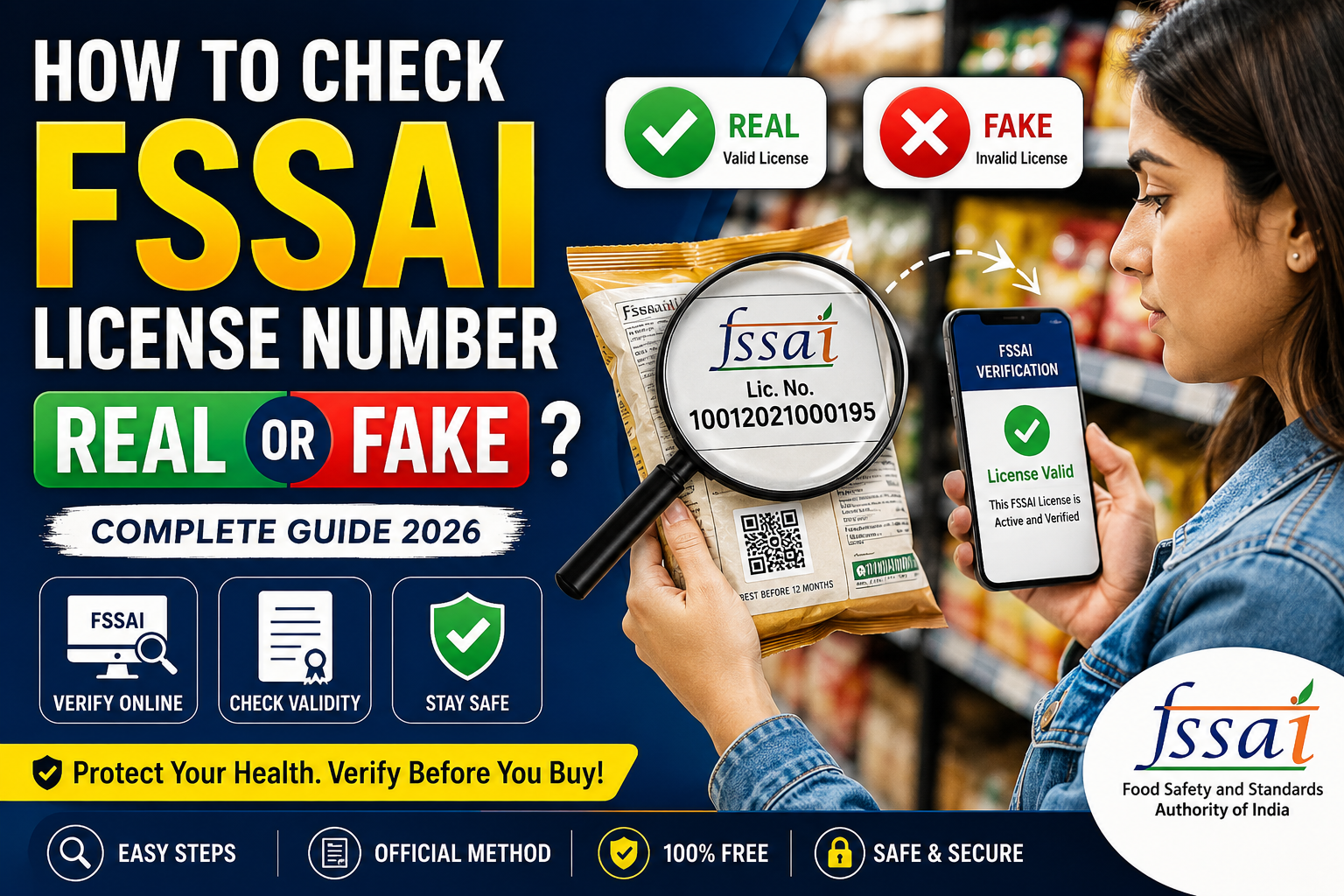
How to Check FSSAI License Number Real or Fake | FSSAI License Verification | Food License Check
Food safety has become one of the biggest concerns for consumers in India. Whether you are buying packaged food, ordering online, eating at a restaurant, or selecting a food manufacturer, verifying the FSSAI license number is an essential step.
Many fake food businesses use copied or invalid license numbers to gain customer trust. Fortunately, the Food Safety and Standards Authority of India (FSSAI) allows anyone to verify a food license online within minutes.
In this detailed guide, you'll learn how to check FSSAI license number real or fake, understand the verification process, identify fake licenses, and know what to do if you discover fraud.
What is an FSSAI License Number?
An FSSAI License is a unique 14-digit identification number issued by the Food Safety and Standards Authority of India to Food Business Operators (FBOs).
This number confirms that the business complies with India's food safety regulations.
It is mandatory for:
-
Restaurants
-
Hotels
-
Cloud Kitchens
-
Food Manufacturers
-
Dairy Businesses
-
Bakers
-
Grocery Stores
-
Importers
-
Exporters
-
Wholesalers
-
Retailers
-
Food Delivery Kitchens
-
Caterers
Why Should You Verify an FSSAI License?
Verifying a food license helps you:
-
Avoid fake food businesses
-
Ensure food safety compliance
-
Confirm license validity
-
Check expiry date
-
Verify business address
-
Confirm product category
-
Avoid counterfeit packaged foods
-
Ensure legal compliance before business partnerships
What Does a 14-Digit FSSAI License Number Mean?
Every digit has significance.
Example:
10012022000123
It contains information regarding:
-
State code
-
Registration type
-
Year of registration
-
Business identification
The number is unique for every registered food business.
How to Check FSSAI License Number Real or Fake?
Follow these steps.
Step 1: Visit the Official FoSCoS Portal
Open the official Food Safety Compliance System (FoSCoS).
Step 2: Click on "FBO Search"
Choose the option to search food business operators.
Step 3: Enter the 14-Digit License Number
Type the complete FSSAI License Number.
Double-check every digit.
Step 4: Enter Captcha
Fill in the security code.
Step 5: Click Search
Within seconds, the portal displays:
-
Business Name
-
License Number
-
Address
-
License Type
-
Validity
-
Product Category
-
State
-
Status
If no result appears, the number may be fake, expired, or incorrect.
Information Displayed During FSSAI Verification
The portal usually shows:
-
Business Name
-
Registered Address
-
License Number
-
Registration Type
-
State License
-
Central License
-
Registration Certificate
-
License Status
-
Date of Issue
-
Expiry Date
-
Product Category
-
Food Business Type
How to Identify a Fake FSSAI License?
Here are common warning signs.
1. Invalid Number
The portal returns:
"No Record Found"
2. Different Business Name
If the displayed business doesn't match the packaging, the license may be fake.
3. Wrong Address
Compare the official address with the business address.
4. Expired License
Never purchase food from businesses with expired licenses.
5. Incorrect Food Category
For example,
A dairy business should not appear as a spice manufacturer.
6. Tampered Certificate
Watch for:
-
Blurry logos
-
Edited PDFs
-
Incorrect fonts
-
Cropped QR Codes
-
Missing digital details
Can You Verify FSSAI License Using QR Code?
Yes. Many newer FSSAI certificates contain QR codes. Scanning them may redirect you to official verification details. Always ensure the QR code leads to an official government website.
How to Verify FSSAI Certificate Online?
You can verify:
-
Registration Certificate
-
State License
-
Central License
The official portal confirms whether the certificate is genuine.
Difference Between Registration and License
|
FSSAI Registration |
FSSAI License |
|---|---|
|
Small Businesses |
Medium & Large Businesses |
|
Basic Registration |
State/Central License |
|
Lower Turnover |
Higher Turnover |
|
Simple Compliance |
Detailed Compliance |
Common Reasons Why an FSSAI Number Doesn't Work
Several reasons may cause verification failure.
Incorrect Number
One wrong digit causes search failure.
Expired License
The license may no longer be valid.
Recently Issued License
Sometimes database updates take time.
Fake Certificate
The number was never issued.
Who Should Verify FSSAI Licenses?
Everyone involved in food purchases should verify licenses.
Including:
-
Consumers
-
Retailers
-
Supermarkets
-
Restaurant Owners
-
Food Manufacturers
-
Wholesalers
-
Importers
-
Exporters
-
Online Food Sellers
-
Grocery Chains
Benefits of Verifying FSSAI License
Verification helps:
-
Prevent food fraud
-
Build customer trust
-
Ensure legal compliance
-
Confirm genuine businesses
-
Avoid counterfeit products
-
Protect public health
What Happens If Someone Uses a Fake FSSAI License?
Using a fake food license may lead to:
-
Heavy penalties
-
License cancellation
-
Business closure
-
Legal prosecution
-
Product seizure
-
Criminal action
How Businesses Can Protect Their Customers
Food businesses should:
-
Display license number clearly
-
Renew licenses before expiry
-
Update address promptly
-
Print valid FSSAI number on packaging
-
Use authentic certificates only
Tips Before Buying Food Products
Always check:
-
Manufacturing date
-
Expiry date
-
FSSAI License Number
-
Packaging quality
-
Batch number
-
Manufacturer details
Online Food Delivery and FSSAI Verification
Before ordering from:
-
Restaurants
-
Cloud Kitchens
-
Home Kitchens
You should verify their FSSAI license whenever possible.
Can Consumers Report Fake FSSAI Licenses?
Yes.
If you find suspicious information:
-
Report to Food Safety Department
-
Contact State Food Authority
-
File an online complaint
-
Keep photographs and purchase receipts
Mistakes People Make During Verification
Avoid these mistakes.
-
Entering incomplete numbers
-
Checking unofficial websites
-
Ignoring expiry dates
-
Trusting edited certificates
-
Not comparing business details
FSSAI License Renewal
Food businesses should renew licenses before expiration to avoid penalties and maintain compliance.
Failure to renew may result in suspension or cancellation.
Frequently Asked Questions (FAQs)
1. How do I check if an FSSAI license number is real?
You can verify an FSSAI license number by visiting the official FoSCoS (Food Safety Compliance System) portal. Enter the 14-digit FSSAI license or registration number in the FBO Search section to view the business name, license status, validity, address, and other registration details.
Source: https://foscos.fssai.gov.in/
2. What if the FSSAI license number shows "No Record Found"?
If the portal displays "No Record Found," the license number may be entered incorrectly, expired, suspended, or fake. Double-check the 14-digit number before concluding that it is invalid.
Source: https://foscos.fssai.gov.in/
3. Can anyone verify an FSSAI license online?
Yes. The FSSAI verification service is publicly available, allowing consumers, retailers, suppliers, and businesses to verify any valid FSSAI license or registration number free of cost.
Source: https://foscos.fssai.gov.in/
4. Is an FSSAI license number always 14 digits?
Yes. Every valid FSSAI registration or license number consists of 14 digits, which uniquely identify the registered Food Business Operator (FBO).
Source: https://fssai.gov.in/
5. How can I identify a fake FSSAI certificate?
A fake certificate may have an invalid license number, mismatched business details, altered formatting, incorrect logos, or a QR code that doesn't verify through the official portal. Always verify the license number on FoSCoS.
Source: https://foscos.fssai.gov.in/
6. What information is displayed after FSSAI verification?
The verification result generally includes the business name, registered address, license type (Registration/State/Central), validity period, food business category, and current license status.
Source: https://foscos.fssai.gov.in/
7. Can I check whether an FSSAI license has expired?
Yes. The official verification portal displays the current status of the license along with its expiry date, helping you determine whether it is active or expired.
Source: https://foscos.fssai.gov.in/
8. Is FSSAI license verification free?
Yes. FSSAI provides a completely free online verification service through its official FoSCoS portal. No registration or payment is required.
Source: https://foscos.fssai.gov.in/
9. Can I verify an FSSAI certificate using a QR code?
Yes. Many newly issued FSSAI certificates include a QR code that can be scanned to verify certificate authenticity. However, you should always cross-check the license number on the official FoSCoS portal.
Source: https://fssai.gov.in/
10. What should I do if I find a fake FSSAI license?
If you suspect a fake or fraudulent FSSAI license, report it to the concerned Food Safety Department or file a complaint through the official FSSAI grievance and consumer complaint system.
Source: https://fssai.gov.in/ | https://foscos.fssai.gov.in/
11. Can I verify both FSSAI Registration and FSSAI License?
Yes. The FoSCoS verification portal allows you to verify both Basic FSSAI Registration and State/Central FSSAI Licenses using the 14-digit registration or license number.
Source: https://foscos.fssai.gov.in/
12. Why is FSSAI license verification important?
Verifying an FSSAI license helps ensure that the food business is legally registered, complies with food safety regulations, and operates under the Food Safety and Standards Act, 2006.
Source: https://fssai.gov.in/
Conclusion
Verifying an FSSAI license number is one of the easiest and most effective ways to ensure that a food business is legally registered and compliant with Indian food safety regulations. By checking the 14-digit license number on the official FoSCoS portal, consumers can confirm the authenticity of the business, review its license status, and avoid fake or expired food licenses. Whether you're buying packaged foods, dining at a restaurant, or partnering with a food supplier, taking a few minutes to verify the license helps protect your health, ensures transparency, and promotes trust in the food industry.
1. क्या रजिस्ट्रेशन सालाना नवीकरण होता है?
2. क्या बिना GST नंबर के MSME पंजीकरण हो सकता है?
3. 12 अंकों का एमएसएमई पंजीकरण नंबर क्या है?
4. MSME प्रमाणपत्र क्या है?
5. MSME के अंतर्गत कौन-कौन से उद्योग आते हैं?
6. MSME के लिए कौन पात्र है?
- How to register on GeM portal
- GeM पोर्टल हेल्पलाइन नंबर 2026| कस्टमर केयर, ईमेल | टेंडर सहायता
- GeM पोर्टल क्या है | रजिस्ट्रेशन प्रोसेस, फायदे | सरकारी ऑर्डर पाने का तरीका (2026)
- एमएसएमई पंजीकरण 2026 | प्रक्रिया, लाभ, दस्तावेज़ | Udyam Guide
- जेम लॉगिन: GeM Login और रजिस्ट्रेशन की पूरी जानकारी

